How Do You Test an App Idea With Real Users Before Building It?
Before you pay for an app, find out whether people want it. Here is a step-by-step way to test an idea with real users in a few weeks.
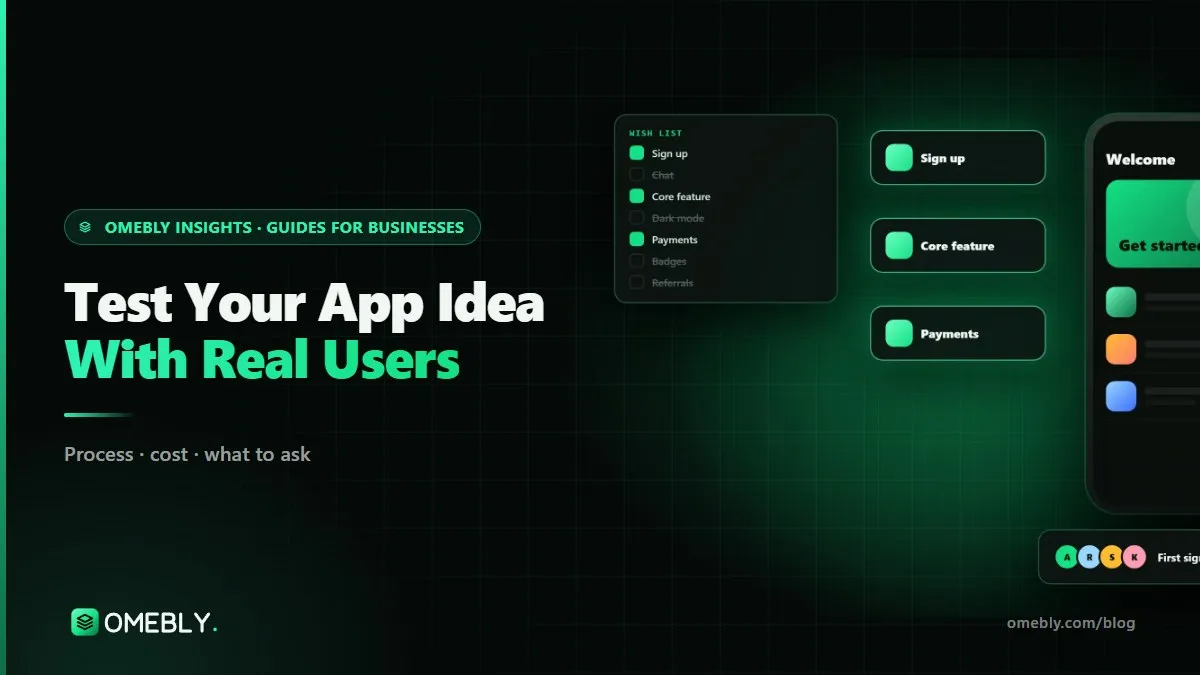
Most failed apps did not fail because of bad code. They failed because nobody needed them badly enough, and the founder found out after spending months and most of the budget. The good news is that you can test demand before writing a line of code. This guide shows how to validate an app idea with real users in a few weeks: who to talk to, what to build (and not build) for testing, and how to decide whether the evidence is strong enough to go ahead. When it is, our MVP app development service turns the validated idea into a first working app.
Quick answer: Validate in five steps: write down your riskiest assumptions, interview 10 to 15 people who have the problem, run a simple landing page to see who signs up or books, test a clickable prototype with five or so target users, and try a manual “concierge” version of the service. Set pass marks before you start, such as how many people must ask to join a pilot, so the result is honest rather than hopeful.
Why validate before you build
Building an app is the most expensive way to test an idea. Even a focused first version needs design, development, a backend, testing and store release. Validation flips the order: you spend days and small amounts proving the idea is worth it, then spend on code with evidence behind you.
Validation answers three questions:
- Is the problem real and painful? Do people actively try to solve it today?
- Is your solution the right shape? Do they understand and want your approach?
- Will they act? Will they sign up, book, pay or come back?
An idea can pass the first test and fail the second. That is still useful: it tells you to change the solution, not abandon the problem.
Step 1: Write down your riskiest assumptions
Before talking to anyone, list what must be true for your app to work. For a home-tutor booking app, for example:
- Parents struggle to find reliable tutors nearby.
- They would book through an app rather than through word of mouth.
- Tutors would accept bookings and fees through the app.
- Parents would pay a booking fee or subscription.
Mark the two or three assumptions that would sink the idea if they were wrong. Those are what you test first. Usually it is not “can this be built?” but “will people change their behaviour?”
Step 2: Interview people who have the problem
Talk to 10 to 15 people who match your target customer. Not friends, not family, and not people who simply like the idea.
How to run a good interview
- Ask about the past, not the future. “Tell me about the last time you looked for a tutor” gives facts. “Would you use an app for this?” gives polite guesses.
- Ask what they do today. If they have a workaround, such as WhatsApp groups, spreadsheets or a local agent, the problem is real.
- Ask what it costs them. Time, money, stress, missed sales.
- Do not pitch. Describe your idea only at the end, if at all, and watch the reaction more than the words.
- Take notes in their words. These phrases become your landing page copy later.
What to listen for
Strong signals: they have tried several solutions, they spend money on the problem now, and they ask when they can try yours. Weak signals: “that sounds cool”, “I might use it”, or nothing they currently do about the problem.
Step 3: Test demand with a simple landing page
A one-page website describing the app’s main benefit, with one clear action, tests whether strangers care.
- Make one promise, in your interviewees’ words.
- Ask for a real action: join the pilot, book a call or pay a small refundable deposit. A bare email sign-up is the weakest signal.
- Send a small, targeted amount of traffic from ads, relevant online groups or partners.
- Measure visits, actions taken and the comments people leave.
Free tools help you judge whether people already search for a solution. Google’s Keyword Planner shows search demand for terms, and Google Trends shows how interest changes over time and by region. Low search volume does not kill an idea, since many new products create demand, but it tells you how much marketing you will need.
Step 4: Test a clickable prototype
A prototype is a set of designed screens linked together, usually in Figma, that feels like an app on a phone but has no real code behind it. It tests whether people understand your solution.
How to run prototype sessions
- Recruit around five target users. Small rounds find most of the big usability problems; run another round after changes.
- Give them a task, such as “book a maths tutor for Saturday”, not a tour.
- Stay quiet and watch. Note where they hesitate, tap the wrong thing or give up.
- Ask afterwards what they expected to happen and whether they would use it.
- Change the design and test again. A fix at this stage takes hours; the same fix after development takes days.
Step 5: Run a manual “concierge” version
Before automating anything, deliver the service by hand to a few customers. For the tutor app, you might match parents to tutors yourself over WhatsApp and a spreadsheet for two weeks.
This tests the hardest question: will people use it and come back? It also shows you which parts of the process matter most, which becomes your must-have feature list. Many app features, such as approvals, matching or payouts, can stay manual for the first users. Our MVP app development guide explains how to turn those lessons into a tight first version.
Set pass marks before you start
Without targets, every result looks encouraging. Agree numbers before each test.
| Test | Weak signal | Strong signal |
|---|---|---|
| Interviews | People agree the problem exists | Most describe a current workaround and what it costs them |
| Landing page | Email sign-ups only | Calls booked, pilot requests or deposits |
| Prototype | People say they like it | People complete the main task without help and ask to use it |
| Concierge pilot | One-off use | Repeat use, referrals or willingness to pay |
Pick your own thresholds based on your market. A business tool with few, high-value customers needs fewer sign-ups than a consumer app.
Validating business apps vs consumer apps
The steps are the same, but the emphasis changes depending on who your customer is.
Business (B2B) app ideas
If you are building for companies, such as a field staff app, a booking tool for clinics or an inventory app for shops, you need fewer conversations but deeper ones. Speak to the person who feels the problem and the person who would approve the spend; they are often different people. The strongest signals are a company agreeing to a paid pilot, sharing real data for a test, or introducing you to colleagues. A letter of intent is useful, but a pilot with a start date is better.
Consumer app ideas
For apps aimed at the public, a single customer matters less and behaviour at scale matters more. Landing page tests and small ad experiments carry more weight, and repeat use in a manual pilot is critical, because consumer apps live or die on whether people come back. Watch for differences between groups, such as age, city or language, since validation may succeed with one group and fail with another.
Marketplaces
If your app connects two sides, such as tutors and parents or drivers and shops, you must validate both. Usually one side is harder to attract. Test that side first, because a marketplace with eager buyers and no sellers, or the reverse, has no product.
Common validation mistakes
- Asking leading questions. “Wouldn’t it be great if…” always gets a yes.
- Interviewing the wrong people. Ten enthusiastic friends are worth less than three real customers.
- Counting compliments as evidence. Look for actions: time, money, commitment.
- Building the prototype too polished. People comment on colours instead of the flow.
- Skipping the manual pilot. It is the cheapest way to see repeat behaviour.
- Hiding from bad news. A failed test is information you would otherwise pay far more to learn.
App idea validation checklist
- Riskiest assumptions written down and ranked
- 10 to 15 interviews with real target users, notes in their words
- Landing page live with one promise and one strong action
- Clickable prototype tested with around five users, then improved
- Manual pilot run with a few real customers
- Pass marks set before each test and results compared honestly
- Must-have feature list written from what users actually did
How Omebly can help
Omebly works with founders from the first prototype to a launched app. Our prototype sprint includes a scoping workshop, a clickable Figma prototype of your core flow and feedback sessions with target users, ending in a written feature plan. When the evidence says go, we build a Flutter app for Android and iOS with analytics in place from day one, so you keep learning after launch.
Projects are led by founder Nazmul Hussain, who brings 10+ years of his own experience building apps and digital products, and an NDA is available on request. See our wider app development services, or read how our MVP app development company service keeps a first version small.
Have an idea you want to test? Contact us for a free consultation.
Frequently asked questions
How long does it take to validate an app idea?
A focused round of interviews, a landing page test and prototype sessions can often be done in three to six weeks, depending on how easy your target users are to reach. It is far shorter and cheaper than building first and finding out later.
Can friends and family validate my idea?
Not reliably. They want to be supportive and are rarely your real target users. Talk to strangers who match your target customer and who currently have the problem you are solving.
Should I sign an NDA with people I interview?
Usually it is unnecessary for interviews, because you are asking about their problems, not revealing your full plan. If you share sensitive details with a design or development partner, an NDA is reasonable and common.
What if validation shows people do not want my app?
That is a good result, because it saved you the cost of building. Look at what you learned: perhaps the problem is real but the solution is wrong, or a different customer group cares more. Adjust and test again.
Is a waitlist sign-up real validation?
It is a useful early signal, but a weak one, because signing up costs nothing. Stronger signals include people booking a call, paying a deposit, joining a pilot or using a manual version of the service more than once.
Do I need a developer to validate an idea?
Not for most of it. Interviews, a landing page and a manual pilot need no code. A designer can build a clickable prototype without development. Bring in developers once the evidence says the idea is worth building.
Written by
Nazmul Hussain, Managing Director & Technical Head, Omebly. 10+ years building websites and apps for clients in India, the Gulf, the UK and the US, and mentoring at Omebly Academy. LinkedIn · GitHub
Follow Omebly
New guides, work and launches on every channel.