




Founders with a game idea
A playable 2D prototype early, so you can test the core loop before paying for full content.
Omebly PDF Tools
Edit PDFRotate PDFHeader and footerBates numberingResize PDFEdit metadataPDF bookmarksAdd page numbersAdd watermarkCrop PDFCreate PDF formFill PDF formsMerge PDFSplit PDFRemove pagesExtract pagesOrganise PDFPages per sheetScan to PDFBatch PDFCompress PDFGrayscale PDFOptimise for webRemove commentsRepair PDFOCR PDFJPG to PDFPNG to PDFText to PDFMarkdown to PDFEPUB to PDFWord to PDFPowerPoint to PDFExcel to PDFHTML to PDFPDF to JPGPDF to PNGPDF to TextExtract imagesPDF to EPUBPDF to WordPDF to PowerPointPDF to ExcelPDF to PDF/AUnlock PDFProtect PDFSign PDFFlatten PDFRedact PDFCompare PDFAI SummarizerTranslate PDFChat with PDFPDF to MarkdownA polished 2D game that feels good under a thumb, built in Unity and ready to submit to Google Play and the App Store.
From $10,000 one-time
A playable 2D prototype early, so you can test the core loop before paying for full content.
A short branded mobile game that people actually finish, with your art style and no gambling mechanics.
Simple, touch-friendly learning games with clear feedback and gentle difficulty.
The core loop, controls, levels, progression and monetisation written down before art starts.
A grey-box build on your own phone to prove the main mechanic is fun.
Characters, backgrounds and UI drawn for your art style, rigged or frame-animated and packed into optimised sprite sheets.
Tap, swipe, drag and virtual-stick controls tuned on real devices, with haptic feedback where it helps.
Hand-built or rule-based levels with a progression that ramps up without frustrating new players.
Effects and music sourced or produced to fit, mixed so they work on phone speakers.
AdMob or Unity Ads placements and in-app purchase hooks, only if your plan needs them.
Signed Android and iOS builds, icons, screenshots and listing text prepared for review.
Most of the games people actually play on the bus or in a queue are 2D: puzzles, runners, platformers, merge games and simple arcade titles. As a mobile game development company focused on this space, Omebly designs and builds 2D games for Android and iOS in Unity, from the first sketch of the idea to the files you submit to Google Play and the App Store.
2D is a good fit when the game depends on a clear, readable screen and quick sessions. It also suits founders testing a first game, brands that want a short playable campaign, and education products that need something friendly and touch-first. Part of our game development service at Omebly Game Development, this page is about 2D on phones specifically. If you want depth, camera movement and 3D characters, see our 3D game development page instead.
Every project starts with a short game design document. It sets out the core loop (what the player does again and again), the controls, how levels are structured, how difficulty rises, and whether the game earns through ads, in-app purchases or a one-off price. Writing this down first stops the most common problem in small game projects: art being produced for features that later change.
Next comes a playable prototype. It uses plain shapes rather than finished art, and it runs on your own phone. This is where we test the thing that decides whether a mobile game works at all: how it feels under a thumb. Jump height, swipe sensitivity, how long a tap takes to register and how forgiving the hit boxes are all get tuned here.
Once the mechanic feels right, production adds the 2D art and animation. We work in your chosen style, whether pixel art, flat vector or hand-painted. Characters are either frame-animated or rigged with bones in Unity’s 2D tools, and everything is packed into sprite atlases so the game loads quickly and uses little memory. Menus, settings, a pause screen and a simple tutorial are designed to work one-handed on small screens.
Sound matters more than people expect on mobile. We add effects for every important action and music that loops cleanly, mixed so it still works through a phone speaker.
If your plan includes ads or in-app purchases, we place them where they fit the flow, such as an optional ad to continue a run or a banner on the menu, not in the middle of play. We keep them simple and clear, and there are no gambling, betting or real-money mechanics in anything we build.
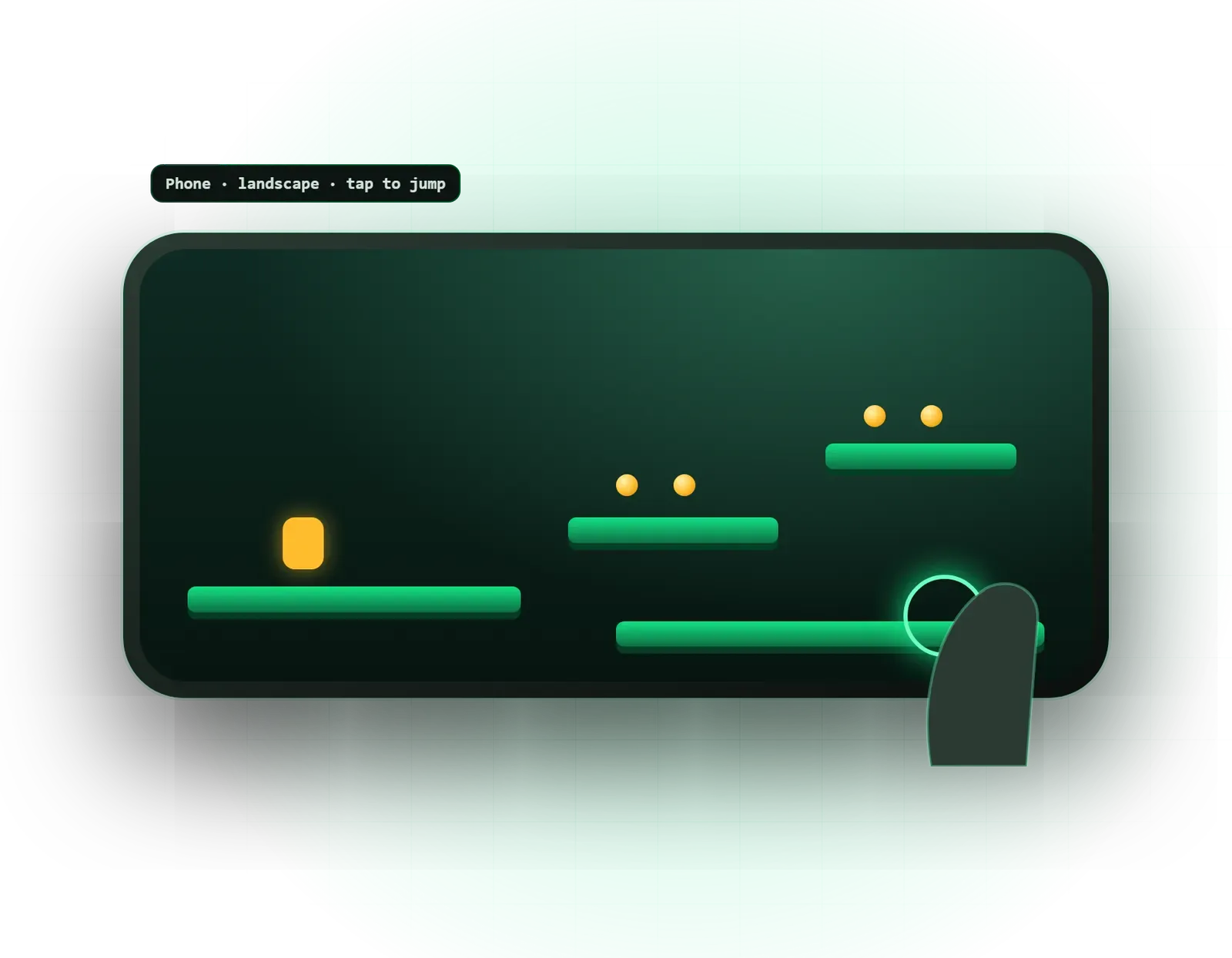
Portrait or landscape. Portrait suits one-thumb play and quick sessions; landscape suits platformers and two-thumb controls. We decide this with you in the design stage because it changes every screen.
A 2D layout has to work on a small budget Android phone and on a tall iPhone with a notch. We use Unity’s safe areas and scale the camera so nothing important sits under a notch or a rounded corner.
Pixel art needs careful camera and import settings to stay crisp. Vector or painted art needs good compression so file sizes stay small. Your style choice affects the build size and the art time, so we explain the trade-off before you commit.
Hand-built levels give the most control. Rule-based or procedural levels give more content for the time spent. Many casual games mix both: hand-made early levels to teach, then generated ones later.
We agree a minimum supported device at the start and test on real low and mid-range phones every week, not only in the editor. Draw calls, overdraw from transparent sprites and memory spikes are checked early, because they are much harder to fix at the end. Our game optimisation work covers this in more depth for existing games.
We do not quote a fixed timeline before we understand the game. As a rough guide, the stages above run from a few weeks for a prototype to a few months for a finished casual game. The things that move the timeline and the price most are:
The starting price for a casual mobile game is shown on the parent service page. Your final figure comes in a fixed written quote after the free consultation, so you know it before work begins.
Every project is led by our founder, Nazmul Hussain, who has 10+ years building websites, apps and digital products. You get a fixed written quote within 48 hours of the consultation, milestone payments that you release only after you have played the build, and a new build to try every week.
Once the project is fully paid, you own the source code, the art we created and the accounts we set up. An NDA is available on request if your idea is not public yet. Bugs in code Omebly wrote are fixed free under our support policy; new levels and features are quoted separately as small fixed jobs.
We also build multiplayer games of our own: the Omebly App, currently in testing on Android, includes Ludo and chess rooms that our team built in-house.
Have a game idea you want to see on a phone? Message us on WhatsApp at +91 70444 33991 or book a free consultation.
We talk through the idea, reference games, target players and devices, then send a fixed written quote.
We agree the loop, controls, level plan and art direction in writing.
A rough but playable build on your phone to test feel before art is produced.
Art, levels, sound, UI and monetisation are added, with a new build to play each week.
Device testing, performance checks and preparing the store submissions with you.
From $10,000 one-time. Every project gets a fixed written quote after a free consultation, with milestone payments.
From $10,000
Fixed quote
Fixed quote
| Omebly | A template or asset-store game kit | |
|---|---|---|
| Core mechanic | Designed and prototyped around your idea | Whatever mechanic the kit ships with |
| Art style | Drawn for your game and audience | The same assets other games already use |
| Feel on real phones | Controls and frame rate tuned on Android and iPhone devices | Often tested only in the editor |
| Store review readiness | Builds and listing files prepared against current store policies | Reskinned kits can be flagged as repetitive content |
| Code quality | Clean C# you own and can extend | Kit code you must learn and untangle |
| Bug fixes | Bugs in code Omebly wrote fixed free under the support policy | Depends on the kit seller |

A good 2D mobile game starts as one action that feels great under a thumb. Here is how to grow that action into a game people return to.
Unity had a rocky couple of years, but it still powers a large share of mobile games. Here is an honest look at when it is the right engine for yours.
Unity, Unreal and Godot can all make great games. Here is how they differ for a beginner, from language and hardware to licences and mobile builds.
2D games usually load faster, run smoothly on older and cheaper phones, and take less art time, so more of the budget goes into gameplay and levels. Puzzle, casual, platformer and top-down genres often read more clearly in 2D on a small screen. If your idea depends on camera movement or depth, we will say so and suggest our 3D service instead.
We can build a game in the same genre and with similar mechanics, because game rules and genres are not owned by one studio. We will not copy another game's characters, art, name, levels or code. During the design document stage we help you find a twist, theme or mechanic that makes your version feel like its own game.
We agree a minimum device and Android version at the start and test on real low and mid-range phones, not only flagships. Sprite atlases, compressed audio and a light memory footprint help 2D games run well on modest hardware. If a feature would hurt performance on your minimum device, we flag it before building it.
We cannot promise approval, because the stores make that decision. What we do is prepare signed builds, privacy details, age ratings and listing assets against the current store policies, and help you respond if a reviewer asks for changes. Your developer accounts stay in your name, which both stores expect.
Yes. Hyper-casual games have one simple mechanic, short sessions and quick restarts, and they rely on that first few seconds feeling right. We prototype several variations of the core action quickly so you can choose the version that plays most naturally before we add polish, levels and ad placements.
Often, yes. Unity can export the same 2D game to WebGL so it runs in desktop and mobile browsers, though some features such as in-app purchases work differently on the web. If a browser version matters, tell us early so controls and file size are planned for both. Our WebGL games page covers browser-first projects.
Tell us what you have in mind. You get a free consultation and a fixed quote within 48 hours.
Prefer email? info@omebly.com