

Studios short on artists
Extra 2D or 3D art capacity that follows your style guide and naming rules.
Omebly PDF Tools
Edit PDFRotate PDFHeader and footerBates numberingResize PDFEdit metadataPDF bookmarksAdd page numbersAdd watermarkCrop PDFCreate PDF formFill PDF formsMerge PDFSplit PDFRemove pagesExtract pagesOrganise PDFPages per sheetScan to PDFBatch PDFCompress PDFGrayscale PDFOptimise for webRemove commentsRepair PDFOCR PDFJPG to PDFPNG to PDFText to PDFMarkdown to PDFEPUB to PDFWord to PDFPowerPoint to PDFExcel to PDFHTML to PDFPDF to JPGPDF to PNGPDF to TextExtract imagesPDF to EPUBPDF to WordPDF to PowerPointPDF to ExcelPDF to PDF/AUnlock PDFProtect PDFSign PDFFlatten PDFRedact PDFCompare PDFAI SummarizerTranslate PDFChat with PDFPDF to MarkdownEngine-ready 2D and 3D art and levels that match your style guide and stay inside your performance budget.
From $10,000 one-time
Extra 2D or 3D art capacity that follows your style guide and naming rules.
Finished characters, props and environments that drop straight into your Unity or Unreal project.
A consistent art direction and level layouts that make the game look and play like a real product.
Colour, shape language, proportions and reference sheets so every asset looks like it belongs.
Concept, model or sprite, textures, rig and the animation set your game needs.
Buildings, terrain pieces and props built from low to high poly as your platform allows.
Snap-together walls, floors and set pieces on a shared grid, so levels are fast to build and change.
Clean UVs and shared texture sheets that cut draw calls and memory use.
Skeletal rigs in Blender with clean deformation at knees, elbows and shoulders.
Simple collision shapes so players do not snag on details or fall through floors.
Grey-box layouts, flow and pacing, then art-dressed levels ready to play.
FBX, glTF or sprite sheets imported, set up and tested in your Unity or Unreal project.
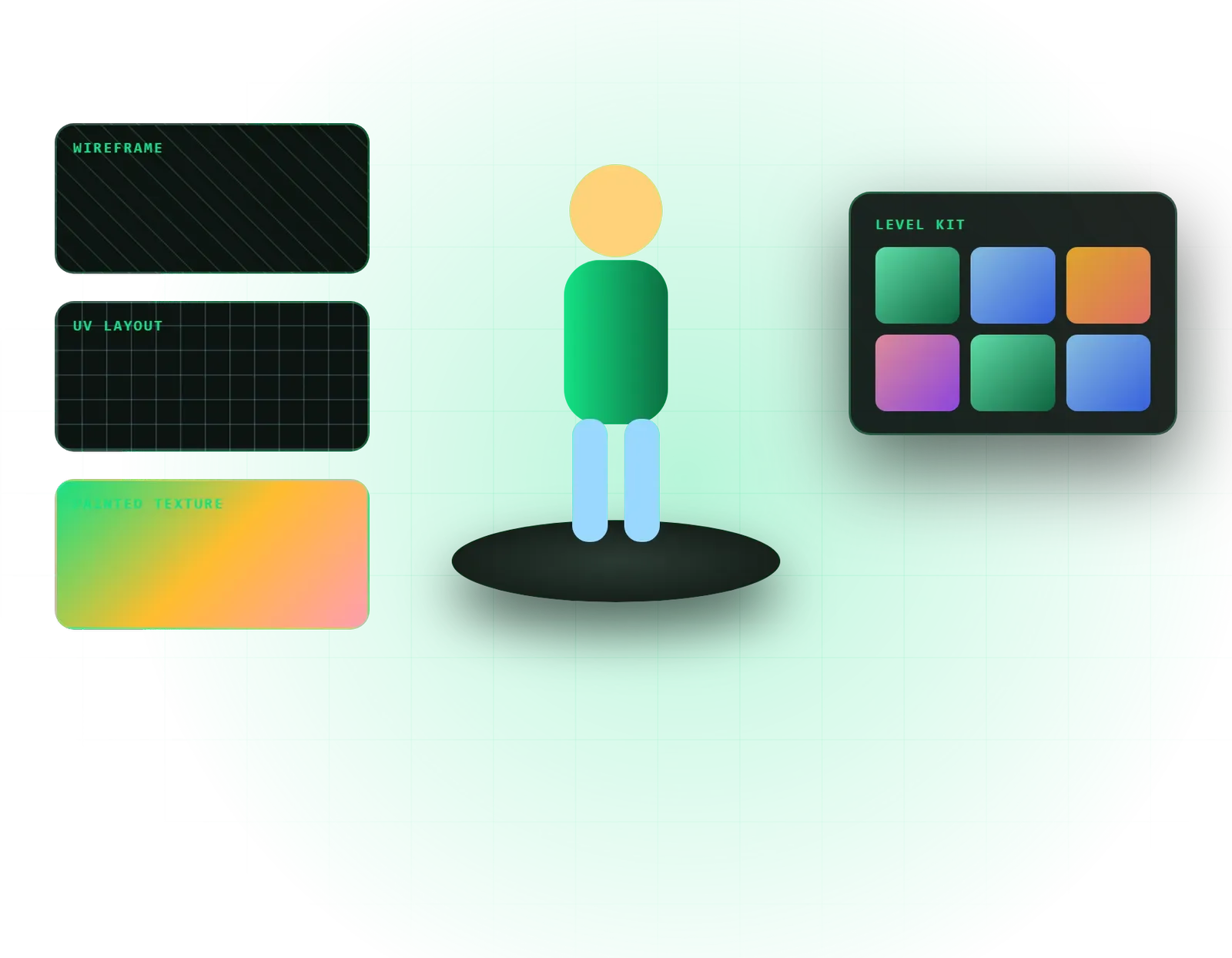
Good game art is not only about how a model looks in a render. It has to animate cleanly, sit inside a polygon and texture budget, share materials with the rest of the scene and import into the engine without hours of fixing. Omebly’s game art outsourcing service covers 2D and 3D characters, environments, props, modular level kits and full level design, delivered ready to use in Unity or Unreal Engine 5.
We work with studios that need more art capacity for a deadline, developers whose prototypes still run on placeholder cubes, and founders who need a clear art direction before full production. The service is part of Omebly Game Development, so our artists work next to programmers who understand how the art will be used.
Art direction and a style guide. Before production, we agree the look: colour palette, shape language, character proportions, texture detail and lighting mood. This goes into a short style guide with reference sheets, so every asset matches, even when several artists work on the project.
For 3D, this covers concept, modelling, UV unwrapping, texturing, rigging, weight painting and the animation set. For 2D, it covers concept, sprites or layered parts for bone animation, and sprite sheets. Rigs are built in Blender with attention to the joints that usually break: shoulders, elbows, knees and hips.
We work across the range from low-poly stylised scenes for mobile to higher-detail assets for PC. Every asset is built to the budget agreed for your platform, with level-of-detail versions where distance allows.
Walls, floors, corners, stairs and set pieces built on a shared grid so designers can assemble levels quickly. Each piece gets a simple collision mesh, so players move smoothly instead of catching on decorative detail.
We paint textures in Substance 3D Painter or Photoshop and pack related assets onto shared texture atlases. Fewer materials mean fewer draw calls, which matters a great deal on phones.
A character usually needs more animations than people expect: idle, walk, run, turn, jump, land, actions, hit reactions and a few personality moves. We list them with you at the start, animate them in Blender or as 2D frames, and set them up so they blend smoothly in the engine.
Menus, buttons, item icons and HUD elements are drawn in the same style as the world, so the game feels like one product rather than a scene with a generic interface on top.
Layout, flow, pacing and challenge are designed in grey-box form first, then playtested, then dressed with final art and a lighting pass.
Art test before batch production. We make one sample asset in your style and test it in your engine. It sets the quality bar and catches mismatches in scale, shading or import settings before they are repeated across fifty assets.
For every asset type we agree a polygon range, texture size, material count and naming convention. These budgets keep the game running smoothly and make the hand-over predictable. If your project is already too heavy, our game optimisation service can help reduce it.
Beauty renders can hide problems. We review every batch inside your Unity or Unreal project, with your lighting, so you see the asset as players will.
Levels are designed and played as plain shapes first. Moving a corridor at this stage takes minutes; moving it after it has been modelled and lit takes much longer.
You receive the Blender, Substance and Photoshop source files, not just the exports, organised and named so your team or a future artist can edit them.
We create original art and do not copy characters or assets from other games. Where you want a familiar genre look, we take the general style, not the specific designs.
Art projects are scoped from an asset list, so your written quote lists every item and its milestone. The factors that change cost most are:
Asset batches arrive weekly, and you pay each milestone after reviewing it. Game project starting prices are shown on the parent service page.
Every project is led by our founder, Nazmul Hussain, who has 10+ years building websites, apps and digital products. Because our artists sit alongside our game developers, art is made with the engine, the camera and the frame rate in mind. You get a fixed written quote within 48 hours, weekly reviews in engine and milestone payments released after review. Once fully paid, the art and source files we created are yours, and an NDA is available on request. For a complete game built around the art, see our 3D game development and 2D mobile game pages.
Send us your references on WhatsApp at +91 70444 33991 or request a free quote.
Your references, platform and budgets reviewed, then one sample asset to agree the style and quality.
A written list of every asset with polygon, texture and naming budgets.
Level layouts built in plain shapes and playtested before art.
Characters, environments and props delivered in weekly batches, reviewed in engine.
Levels dressed with final art, lighting passes and the source files handed over.
From $10,000 one-time. Every project gets a fixed written quote after a free consultation, with milestone payments.
From $10,000
Fixed quote
Fixed quote
| Omebly | Buying asset-store packs | |
|---|---|---|
| Look of the game | A consistent style made for your game | Packs from different artists that rarely match |
| Recognition | Original art players have not seen before | The same assets appear in many other games |
| Performance | Built to your polygon and texture budgets | Often too heavy or uneven for mobile |
| Changes | Adjusted to your levels and gameplay | You edit someone else's files yourself |
| Rights | You own the art we create once fully paid | Licence terms vary by pack |
Most outsourced art problems start with a vague brief. Here is a game art brief template that gives artists what they need to get it right first time.

From idea and game design document to prototype, art, testing and store release: how a Unity mobile game is really made, and what it costs.
Two 3D games that look similar on paper can differ hugely in cost. Here is what actually moves the budget, and how first-time publishers can control it.
Reference images or games whose style you like, your target platforms and engine version, any existing art, and a list of what you need. If you have technical budgets for polygon counts, texture sizes or naming conventions, share them too. If you do not, we write them with you, because they decide how the art performs in the game.
One sample asset made in your style shows whether our interpretation matches yours before a whole batch is produced. It is the quickest way to agree on detail level, colour and finish, and it gives you a real file to test in your engine. Production only starts once you are happy with the test.
Yes. We study your existing assets for proportions, colour, line weight, texture detail and lighting, then write a short style sheet so new work stays consistent. Matching an existing style is common in outsourcing, and the art test confirms we have it right before we produce more.
It is a set of walls, floors, corners, doors and props built on a shared grid so they snap together like building blocks. Designers can build and change many levels quickly, and the game reuses the same meshes and textures, which saves memory. It suits dungeons, cities, interiors and any game with many similar spaces.
Both. Level design is about layout, flow, pacing and challenge; level art is about how it looks. We grey-box layouts first, playtest them to check the route, sightlines and difficulty, then dress them with art. Designing first avoids beautiful levels that are confusing or dull to play.
Our lifetime bug-fix support covers code Omebly wrote, not art direction or visual changes. If an asset we delivered does not meet the agreed specification, such as broken UVs or a rig that deforms badly, we fix it as part of the project. New assets or style changes after delivery are quoted separately.
Tell us what you have in mind. You get a free consultation and a fixed quote within 48 hours.
Prefer email? info@omebly.com