








Businesses with systems that don't talk to each other
Orders, stock and customer records move between your website, ERP and accounting tools without anyone retyping them.
Omebly PDF Tools
Edit PDFRotate PDFHeader and footerBates numberingResize PDFEdit metadataPDF bookmarksAdd page numbersAdd watermarkCrop PDFCreate PDF formFill PDF formsMerge PDFSplit PDFRemove pagesExtract pagesOrganise PDFPages per sheetScan to PDFBatch PDFCompress PDFGrayscale PDFOptimise for webRemove commentsRepair PDFOCR PDFJPG to PDFPNG to PDFText to PDFMarkdown to PDFEPUB to PDFWord to PDFPowerPoint to PDFExcel to PDFHTML to PDFPDF to JPGPDF to PNGPDF to TextExtract imagesPDF to EPUBPDF to WordPDF to PowerPointPDF to ExcelPDF to PDF/AUnlock PDFProtect PDFSign PDFFlatten PDFRedact PDFCompare PDFAI SummarizerTranslate PDFChat with PDFPDF to MarkdownA documented, secure API that connects your website, apps and business systems, built to the scope you sign off.
From $4,000 one-time
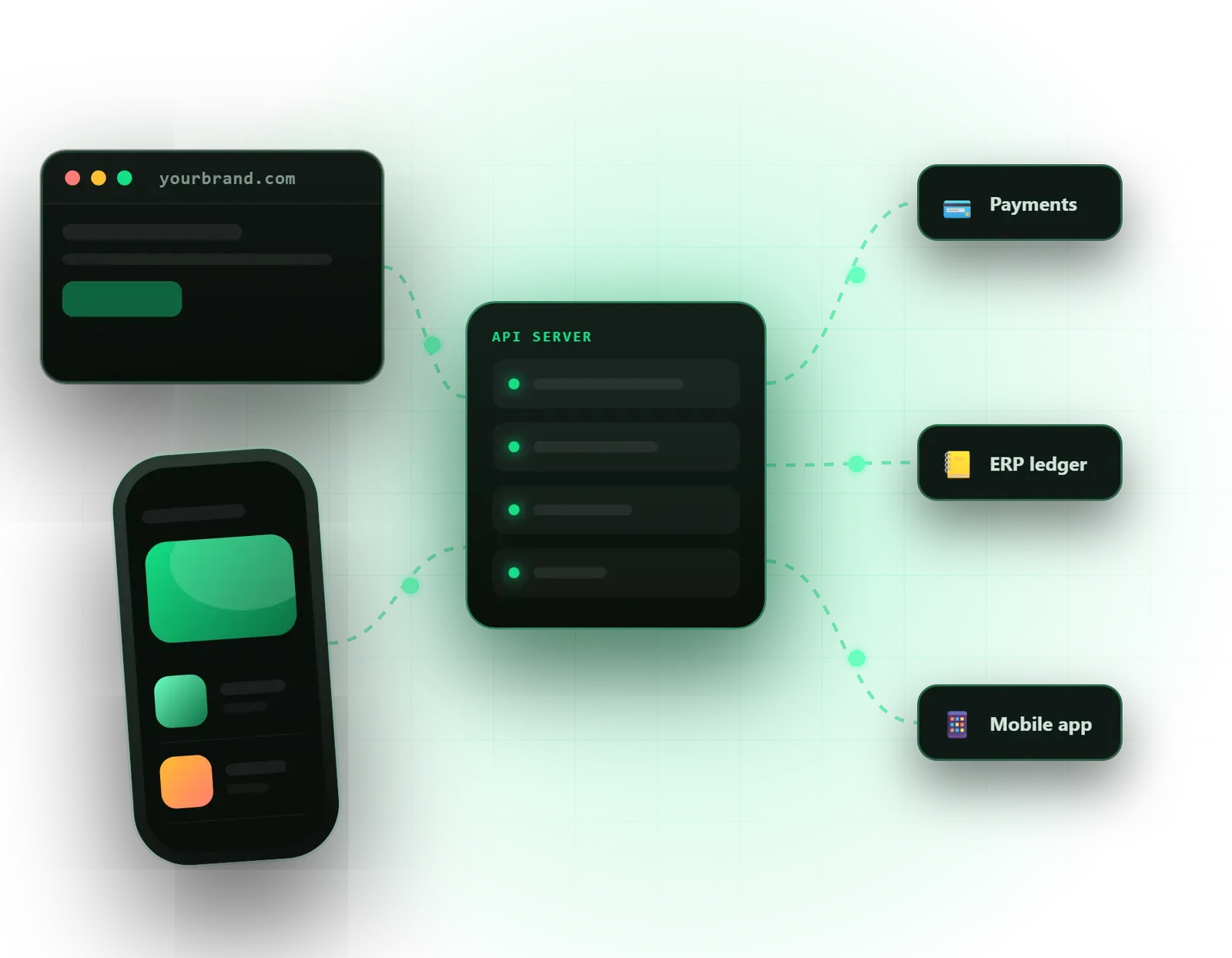
Orders, stock and customer records move between your website, ERP and accounting tools without anyone retyping them.
One backend serves your website and your Android and iOS apps, so features ship once instead of twice.
Partners connect through a documented, permissioned API instead of spreadsheets sent by email.
Endpoints, data shapes and error codes agreed in an OpenAPI specification before coding starts, so front-end and app teams can work in parallel.
REST for simple, cache-friendly resources and GraphQL where apps need to fetch related data in one request, chosen per project.
OAuth 2.0 or token-based sign-in with role-based rules, so each user, app or partner sees only the data they are allowed to.
Connections to payment gateways such as Stripe, PayPal and Razorpay, and to ERP, CRM or accounting systems that offer an API.
Event handlers for payments, orders and status changes, with retries and logging so a missed message doesn't mean a missed sale.
A structured schema with indexes, migrations and backups, planned around how your data will actually be queried.
Swagger-style docs and a Postman collection, so any developer can understand and test the API without asking us.
Request logs, sensible rate limits and error alerts, so problems are visible before your customers report them.
An API is the part of a system that lets one piece of software ask another for data or ask it to do something. Our custom API development services cover the backend work behind that: designing the endpoints, building the logic and database, connecting outside systems and documenting it all so other developers can use it.
Most businesses come to us with one of three problems. Their website, ERP and accounting tool each hold a different version of the truth, so staff copy orders and stock figures between them. Or they are launching a web or mobile app and need one reliable backend behind it. Or partners keep asking for data, and the current answer is a spreadsheet sent every Friday. In each case, the fix is a well-designed API, not another plugin.
This page is about the backend itself. If you need the full product with screens, users and dashboards, see web app development or SaaS development, which include an API like this as one part of the build. API work sits under our wider web development service.
Every project starts with an API contract: a written OpenAPI specification listing each endpoint, the data it accepts and returns, and the errors it can send back. You approve this before we write code. It sounds like paperwork, but it is what lets a mobile team, a front-end team and a partner all build against the same plan at the same time.
From there we build REST or GraphQL endpoints, depending on how the data will be used. Authentication is handled with OAuth 2.0 or tokens, with role-based rules so a warehouse user, a customer and a partner each see only what they should. Integrations cover payment gateways (Stripe, PayPal and Razorpay), ERP, CRM and accounting systems that offer an API, and webhooks that react to events such as a payment clearing or an order shipping.
Around the endpoints sit the parts people forget until something breaks: a database schema with indexes and backups, background jobs with retries, rate limits, request logs and error alerts. You also get interactive documentation and a Postman collection, so your own developers can test every call.
A few decisions shape every API we build, and we make them with you rather than for you.
REST is simple, easy to cache and understood by every partner. GraphQL saves round trips when an app needs related data on one screen. We pick per project, and sometimes use both.
A single, well-organised backend is cheaper to build and run, and right for most businesses. We split parts into separate services only when they genuinely need to scale or be deployed on their own, such as a busy order-sync job.
Some data must move instantly, like a payment confirmation. Other data, like a nightly stock update from an ERP, is safer as a scheduled job that can retry. Choosing the right pattern per flow keeps systems consistent when one of them is slow or offline.
Input is validated, secrets stay out of the code, every call is authenticated and access is logged. We review permissions endpoint by endpoint before go-live.
Our usual stack is Node.js with PostgreSQL, with Redis for caching and queues, Firebase where real-time data or quick authentication suits the app, and Docker for consistent deployments. Hosting is set up in your name.
A single payment or ERP connection is a short project. A full backend with several integrations, roles and background jobs takes longer. The things that move timeline and cost most are:
We don’t publish a one-size timeline. After a free consultation, your fixed written quote sets out the scope, milestones and price, and you see working endpoints in a demo every week. Starting prices for web projects are on the web development page.
Omebly is founder-led. Nazmul Hussain, our MD and Technical Head, brings 10+ years of building websites, apps and digital products, and stays involved in the architecture decisions on your project.
We work with clients from Kolkata, India and Downtown Dubai, with calls in your time zone.
Tell us which systems need to talk to each other and what goes wrong today. Message us on WhatsApp at +91 70444 33991, email info@omebly.com or use the contact form to book a free consultation.
We list every system involved, what data moves where, who triggers it and what must happen when something fails.
We write the OpenAPI specification and data model, and you approve it before any endpoint is built.
Endpoints, authentication and integrations are built in batches and shown in weekly demos with real test calls.
Automated tests, load checks on busy endpoints and a review of permissions, input validation and secrets handling.
Deployment to hosting in your name, documentation hand-over and a walkthrough for your developers.
From $4,000 one-time. Every project gets a fixed written quote after a free consultation, with milestone payments.
From $4,000
Fixed quote
Fixed quote
| Omebly | A freelancer | |
|---|---|---|
| Planning | Written API contract approved before build | Often starts coding from a short brief |
| Documentation | OpenAPI docs and a Postman collection included | Varies; often left until the end or skipped |
| Security | Permissions, validation and secrets reviewed before go-live | Depends on the individual's experience |
| Price | Fixed written quote with milestone payments | Often hourly, so the total can move |
| Continuity | Founder-led team with lifetime bug-fix support on code we wrote | One person; support stops if they move on |
| Ownership | Code, docs and accounts handed over once fully paid | Agreed case by case |
An API contract is the written agreement on how your systems will talk to each other. Here's what it should include, how to review it without being a developer, and why it saves money.
Frontend, backend or full stack? See what each developer actually builds, what you need to learn for each, and a quick way to choose your first path.

How to set up the Meta Conversions API alongside the Pixel, which events and customer data to send, how deduplication works and how to check it is right.
REST suits most business systems: it is simple, easy to cache and every integration partner understands it. GraphQL helps when a web or mobile app needs to pull related data, such as a customer, their orders and their invoices, in a single request. Some projects use both. We recommend one in the integration mapping step, explain why in writing, and record the choice in the API contract you approve.
Usually, yes, as long as the system offers an API, a webhook feature or a supported import format. We first check what the vendor's API actually allows, including rate limits and licence conditions, because some features need a higher plan. If something cannot be automated cleanly, we tell you before the quote rather than after the build starts.
Yes. We agree the API contract with your app team first, then share a mock server and a Postman collection so they can build screens while we build the real endpoints. Weekly demos include test calls from both sides. If you later want Omebly to build the app as well, our app team can work from the same contract.
Every endpoint checks who is calling and what they are allowed to do. We validate all input, keep secrets out of the code, use HTTPS throughout, add rate limits to stop abuse, and log access so unusual activity can be traced. Before go-live we review permissions endpoint by endpoint against the roles agreed in your scope.
Yes, that is why documentation is a deliverable rather than an extra. You receive an OpenAPI specification, interactive docs and a Postman collection, plus setup notes for running the project locally. Once the project is fully paid, the code and accounts are yours, so an in-house developer or another agency can pick it up without starting over.
We build integrations to fail safely: calls are retried, failures are logged and alerts tell you when a partner service is not responding. Changes a vendor makes to its own API after delivery are not covered by lifetime bug-fix support, because that code is not ours. Updating an integration for a new vendor version is usually quoted as a small fixed job.
Yes. We start with a code and security review of the existing API, then send a written report and a fixed quote for fixes and new endpoints. Lifetime bug-fix support then covers the code Omebly writes from that point, not the original code written by the previous developer, unless we rebuild that part as part of the agreed scope.
Tell us what you have in mind. You get a free consultation and a fixed quote within 48 hours.
Prefer email? info@omebly.com