




Startups building a new app
Get a backend sized for your first users that can grow without a rewrite when traction arrives.
Omebly PDF Tools
Edit PDFRotate PDFHeader and footerBates numberingResize PDFEdit metadataPDF bookmarksAdd page numbersAdd watermarkCrop PDFCreate PDF formFill PDF formsMerge PDFSplit PDFRemove pagesExtract pagesOrganise PDFPages per sheetScan to PDFBatch PDFCompress PDFGrayscale PDFOptimise for webRemove commentsRepair PDFOCR PDFJPG to PDFPNG to PDFText to PDFMarkdown to PDFEPUB to PDFWord to PDFPowerPoint to PDFExcel to PDFHTML to PDFPDF to JPGPDF to PNGPDF to TextExtract imagesPDF to EPUBPDF to WordPDF to PowerPointPDF to ExcelPDF to PDF/AUnlock PDFProtect PDFSign PDFFlatten PDFRedact PDFCompare PDFAI SummarizerTranslate PDFChat with PDFPDF to MarkdownA secure, well-documented backend that keeps your app's data, logins, payments and live features working as you grow.
From $8,000 one-time
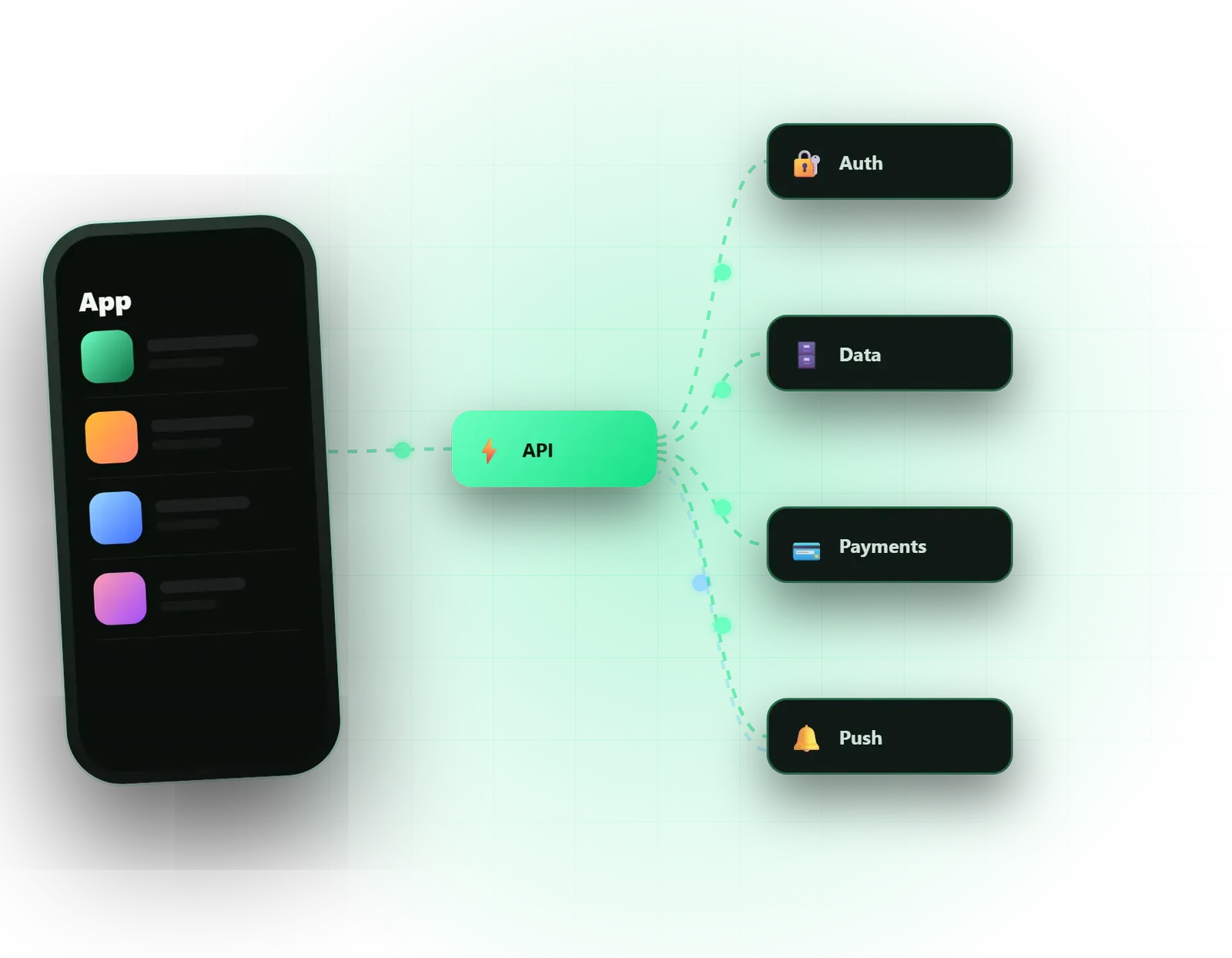
Get a backend sized for your first users that can grow without a rewrite when traction arrives.
Link your app safely to your CRM, ERP, booking or inventory system through clean APIs.
Move from a backend that is slow, costly or hard to change to one built for your current load.
A written choice between Firebase, Supabase or a custom Node.js server, with the reasons and the growth path.
Data models, indexes and access rules designed around how your app actually reads and writes data.
Documented endpoints for the app, the admin panel and any partner systems, with versioning so older app versions keep working.
Email, phone, Google and Apple sign-in, with roles such as customer, staff and admin enforced on the server.
Server-side receipt checks for Apple and Google purchases, and webhooks for payment gateways such as Stripe or Razorpay.
Targeted and scheduled notifications through Firebase Cloud Messaging or OneSignal, triggered by real events.
Local SQLite storage that syncs when back online, plus WebSocket connections for chat, live updates or presence.
Logging, error alerts, automated backups and rate limiting set up in hosting accounts you own.
Bugs in code Omebly wrote are fixed free, as set out in our support policy.
The screens are what users see, but the backend is what makes an app work: it stores accounts and data, checks payments, sends notifications, applies your business rules and connects to your other systems. When it is rushed, problems show up later as slow screens, lost data, security holes or monthly bills that grow faster than your users. Omebly’s mobile app backend development service designs and builds that server side properly, whether your app is new or already live.
This work suits startups building a new app that need a backend sized for now with a clear path to grow, businesses linking a customer or staff app to existing systems, and teams whose current backend is slow, costly or hard to change.
We build and run real-time servers ourselves. Our own app, Omebly App (in testing on Android), uses a Flutter front end with real-time servers for live voice rooms, game logic decided on the server, and encrypted backups. That experience shapes how we plan connections, load and data safety for client apps.
Architecture. We start with a short written plan: Firebase, Supabase or a custom Node.js server, where it is hosted, and how it grows. For a first release, a managed platform often saves weeks. For complex rules, heavy integrations or strict hosting needs, a custom API on PostgreSQL gives more control.
We design the database around how your app reads and writes data, with indexes for the screens that load most often. APIs are documented, tested in Postman and versioned, so older app versions still on users’ phones keep working when the backend changes.
Email, phone, Google and Apple sign-in, with roles such as customer, staff and admin enforced on the server. The app is never trusted to decide who may see what.
For in-app purchases we verify Apple and Google receipts on the server before unlocking anything. For orders and bookings we connect gateways such as Stripe or Razorpay through webhooks, so a payment is confirmed even if the user closes the app.
Push notifications run through Firebase Cloud Messaging or OneSignal, triggered by real events. Chat, presence and live updates use WebSocket connections. For apps used on patchy networks, we store data locally in SQLite and sync it when the phone is back online.
Logging, error alerts, automated backups and rate limiting are set up before launch, in hosting accounts you own.
Start managed, plan for custom. Many apps begin on Firebase or Supabase and never need more. When an app does outgrow them, a clean data model and an API layer make the move gradual rather than a rewrite. We write that path down at the start.
Most backend problems trace back to data that was modelled in a hurry. We agree the data model and API contract before building, which also lets app and backend work happen side by side.
Access rules, price calculations and anything involving money are checked on the server. Secrets stay out of the app, traffic uses HTTPS, and sensitive fields can be encrypted at rest.
We load test at your expected peak, such as a promotion or a live event, and check database queries for slow spots. Knowing the limits before launch is far cheaper than discovering them on the day.
A backend is also used by people inside your business. We build a simple admin panel for managing users, content, orders or refunds, with its own roles and an activity log, so routine changes do not need a developer and you can see who changed what.
After the free consultation you receive a fixed written quote within 48 hours, with the timeline and milestones in writing. A backend for an MVP fits within the 30 to 60-day build sprints described on our app development page, while integration-heavy or real-time systems take longer.
The main factors are:
Hosting is billed to you directly by the provider; we estimate running costs before launch so there are no surprises.
Every project is led by founder Nazmul Hussain, drawing on his 10+ years of building websites, apps and digital products. You get a fixed written quote, milestone payments released only after you have seen the work, and a weekly demo of the backend working inside your app.
Once the project is fully paid, you own the source code, API documentation and hosting accounts we set up. An NDA is available on request. After launch, bugs in code Omebly wrote are fixed free under our support policy; new features, third-party API changes and hosting costs are separate. If you are starting from scratch, pair this with our MVP app development or Flutter app development services.
Tell us what your app needs to do on WhatsApp or through the contact page.
A WhatsApp or video call about your app, expected users, existing systems and budget.
A written quote within 48 hours, followed by a short architecture document agreed before the build.
Database design and API documentation agreed, so app and backend work can run side by side.
Endpoints, integrations and admin tools built in sprints, shown working in the app each week; milestones paid only after review.
Security checks, load testing at your expected peak, backups confirmed and production launch.
Code, documentation and hosting accounts handed over once fully paid, with lifetime bug-fix support after launch.
From $8,000 one-time. Every project gets a fixed written quote after a free consultation, with milestone payments.
From $8,000
Fixed quote
Fixed quote
| Omebly | A ready-made backend template | |
|---|---|---|
| Fit to your app | Data model designed around your features and reports | Generic tables you bend your app to fit |
| Security | Roles and access rules enforced on the server and reviewed | Default rules that are often left too open |
| Documentation | Written API docs and architecture notes handed over | Little documentation beyond the template's own |
| Growth path | A written plan for scaling or moving from managed to custom | Limits appear suddenly when usage grows |
| Ownership | Code and hosting accounts in your name once fully paid | Often tied to the template seller's licence or platform |
| Support | Lifetime bug-fix support for code Omebly wrote | Forum support, if any |
Firebase, Supabase or your own server? Here is how the three compare for a mobile app, and how to pick one without boxing yourself in.
Twelve questions that separate a reliable app partner from an expensive lesson, written for founders and businesses hiring in Dubai and the UAE.
What a mobile app really costs in 2026, how the build works from idea to store release, and how to choose between Flutter and native iOS and Android.
Firebase suits apps that need fast development, real-time updates and push notifications with little server work. Supabase suits apps with relational data, such as orders, bookings or reports, because it runs on PostgreSQL. A custom Node.js backend suits complex business rules, heavy integrations or strict hosting needs. We recommend one in writing, with reasons and the path for growing later.
Usually, yes. If your system has an API, we build a secure layer between it and the app, so the app never holds your system's passwords and only sees the data it needs. If there is no API, we look at exports, database access or middleware. Changes made by the third party later are outside bug-fix support.
We enforce roles and access rules on the server, never only in the app. Passwords are handled by proven sign-in services, traffic uses HTTPS, secrets stay out of the app code, and sensitive fields can be encrypted at rest. We add rate limiting against abuse and set up automated backups that we test by restoring them.
Yes. We use WebSocket connections for chat, typing indicators, presence and live updates, with message queues where volume is high. Our own app, Omebly App (in testing on Android), runs live voice rooms on real-time servers we built, so we plan for reconnects on weak networks and spikes when many users join at once.
Hosting is set up in accounts in your name and billed to you directly by the provider, so you control your data and costs. We choose a region close to your users, for example in India, the UAE or Europe, and we explain the expected monthly running costs before launch. Hosting fees are not part of our price.
Often, yes. We start with a paid review of the code, database, hosting setup and error logs, then give you a written plan to stabilise, extend or gradually replace it. We keep the app working during any change. Lifetime bug-fix support then applies to code Omebly writes, not to the code we inherited.
Tell us what you have in mind. You get a free consultation and a fixed quote within 48 hours.
Prefer email? info@omebly.com