Frontend vs Backend vs Full Stack: Which Web Developer Path Fits You?
Frontend, backend or full stack? See what each developer actually builds, what you need to learn for each, and a quick way to choose your first path.
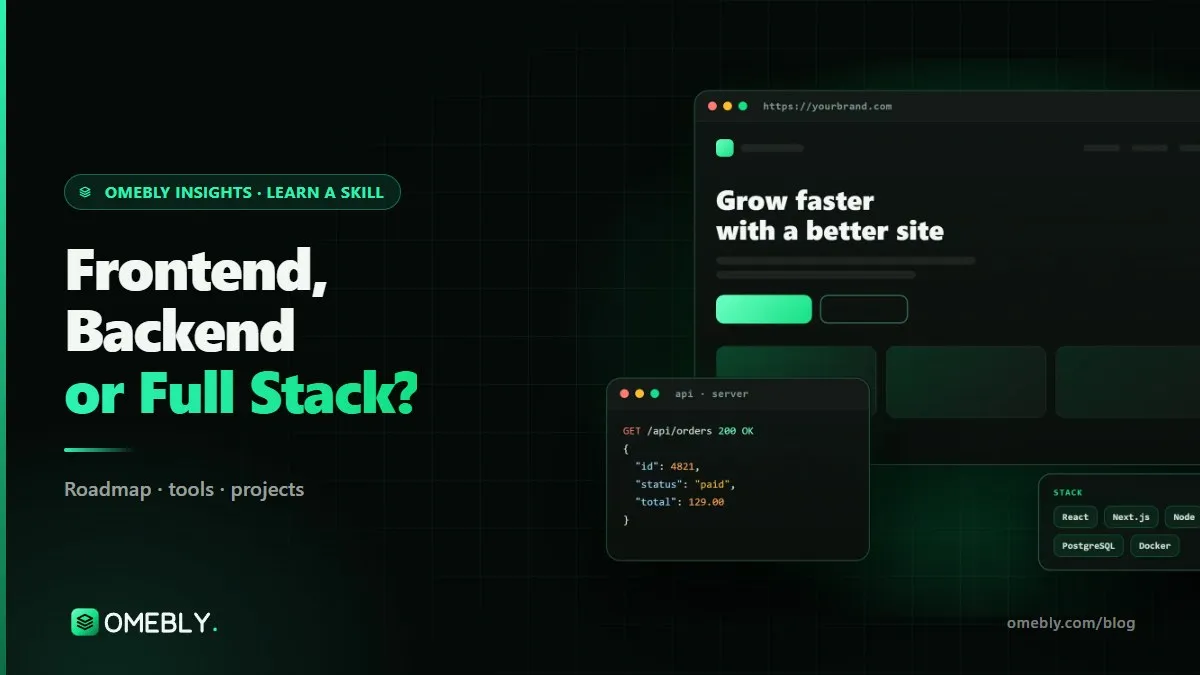
Every website and web app has two halves: the part you see and the part you don’t. Choosing between them is one of the first decisions a new developer faces, and the frontend vs backend developer question confuses many beginners because job titles overlap. This guide explains what each role builds, the skills behind it, and how to decide. If you would rather learn both with a mentor, Omebly Academy’s Full-Stack Web Development course covers the full path.
Quick answer: Frontend developers build what users see and click in the browser, using HTML, CSS, JavaScript and frameworks such as React. Backend developers build the server side: APIs, databases, logins and business logic, using tools such as Node.js and PostgreSQL. Full stack developers do both. Most beginners learn frontend basics first, then add backend, and choose a specialism once they know which half they enjoy.
A simple way to picture it
Think of a food delivery app:
- Frontend: the menu screen, the photos, the “Add to cart” button, the animation when your order is confirmed.
- Backend: checking the restaurant is open, saving your order, charging your payment, telling the delivery partner, and sending a notification.
- Database: where restaurants, menus, orders and users are stored.
When you tap “Place order”, the frontend sends a request to an API on the backend, the backend talks to the database, and a response comes back to update the screen. Full stack developers can build that whole round trip.
What a frontend developer does
Frontend developers turn designs into working, responsive interfaces.
Typical tasks
- Build layouts that work on phones, tablets and desktops.
- Turn a Figma design into reusable components.
- Handle forms, validation and error messages.
- Fetch data from APIs and show loading, empty and error states.
- Make pages fast and accessible to keyboard and screen-reader users.
Core skills
HTML, CSS (Flexbox and Grid), JavaScript, a framework such as React, often Next.js and TypeScript, plus Git and browser developer tools. MDN’s learning area is the standard free reference.
You might enjoy frontend if…
You care how things look and feel, you notice when a button is misaligned, and you like seeing your work immediately.
What a backend developer does
Backend developers build the logic and data that power the interface.
Typical tasks
- Design and build REST APIs.
- Design database tables and write queries.
- Handle sign-up, login and permissions securely.
- Integrate payments, email, SMS and other services.
- Make sure the system stays fast and correct as data grows.
Core skills
A server language and framework (for example Node.js with Express, or Python), SQL and a database such as PostgreSQL or MongoDB, authentication, API design, and basic security. If you go this way, joins and data modelling matter a lot; our SQL joins guide is a good place to practise.
You might enjoy backend if…
You like logic puzzles, data and systems, and you are happy when something works correctly even if nobody ever sees it.
What a full stack developer does
A full stack developer can build a feature from database to screen. In small companies and startups, this is very common: one developer might add a “save to wishlist” feature by creating the database table, writing the API and building the button.
Full stack does not mean expert in everything. Most full stack developers lean towards one side and are comfortable on the other. Our full stack web development roadmap shows the stages in detail.
Frontend vs backend developer: side-by-side comparison
| Frontend | Backend | Full stack | |
|---|---|---|---|
| Builds | Interface in the browser | APIs, logic, data | The whole feature |
| Main languages | HTML, CSS, JavaScript/TypeScript | JavaScript (Node.js), Python, Java, others | Both sides |
| Key tools | React, Next.js, browser dev tools | Express, PostgreSQL/MongoDB, Postman | All of these, plus deployment |
| You see results | Instantly on screen | Through API responses and tests | Both |
| Typical worries | Layout bugs, performance, accessibility | Security, data accuracy, scaling | Everything in between |
| Works closely with | Designers | Database and DevOps people | Everyone |
Roles next door to the stack
Web teams include more than frontend and backend developers. Knowing the neighbouring roles helps you see where your path could lead later.
- UI/UX designer: decides how the product works and looks, usually in Figma, before frontend developers build it. Frontend developers with a good eye often move this way.
- DevOps or cloud engineer: handles servers, deployment pipelines, monitoring and uptime. Backend developers who enjoy infrastructure often drift here.
- Mobile developer: builds Android and iOS apps, often with Flutter or React Native, and talks to the same backend APIs as the website.
- QA or test engineer: writes automated tests and checks that features work before release.
- Database or data engineer: designs data storage and pipelines for reporting and analytics.
None of these is a dead end from web development. The fundamentals you learn on either side of the stack, such as HTTP, APIs, Git and clean code, carry over to all of them.
A day in each role
A frontend day might start with a design review, then building a new checkout screen, fixing a layout bug that only appears on small Android phones, and pairing with the backend developer to agree what the order API returns.
A backend day might involve designing a table for discount codes, writing an API to apply them, adding tests so a code can’t be used twice, and checking why one report query is slow.
A full stack day mixes both, often on a single feature from start to finish, with more context switching.
How to choose your path: a quick self-test
Answer honestly:
- When you use an app, do you notice the design and animations, or wonder how the data is stored?
- Would you rather fix a broken layout or a wrong total in a report?
- Do you enjoy visual detail, or prefer logic and structure?
- Do you like working with designers, or with data and systems?
Mostly the first option points to frontend; mostly the second points to backend. A mix suggests full stack. The good news: you don’t need to decide on day one.
The order most people should learn in
- HTML, CSS and JavaScript basics. Every path needs them.
- Git and GitHub. From the first week.
- A frontend framework (React). Build real interfaces.
- A backend (Node.js and Express) and a database. Connect your interface to real data.
- Deploy a full project. Then decide where to go deeper.
By step 5 you will know from experience which half you enjoy, which is far more reliable than guessing at the start.
Projects that show each skill
- Frontend: a responsive landing page from a Figma design, a product filter page with search, an accessible multi-step form.
- Backend: a REST API for a library or booking system with authentication, a URL shortener with click counts, a reporting API with SQL aggregations.
- Full stack: a blog with an admin panel, a small online store with cart and checkout, a real-time chat app.
Deploy each project and keep the code on GitHub with a short README explaining what you built and why.
Mistakes beginners make when choosing
- Choosing by job-title hype. Pick by what you enjoy building; you will practise it for hundreds of hours.
- Skipping fundamentals for a framework. React without solid JavaScript leads to copy-paste code you can’t debug.
- Avoiding the other side completely. Frontend developers who understand APIs, and backend developers who understand the browser, are much easier to work with.
- Never deploying. A project on your laptop is invisible. Ship it.
- Learning five languages at once. Go deep with one stack first; switching later is easier than you think.
Path readiness checklist
- I can build a responsive page from a design
- I can fetch data from an API and handle errors
- I have built and deployed one API with a database
- My projects are on GitHub with clear READMEs
- I know which half I enjoy more, from experience
Learn it with Omebly
Omebly Academy’s Full-Stack Web Development course follows exactly this order, with a live mentor: HTML, CSS and JavaScript first, then React, then Node.js, Express and PostgreSQL or MongoDB, with deployment from month three. Classes are live with recordings and weekly one-to-one reviews, and a free first call checks your level.
- Core (3 months, $699): web foundations, React, Node.js and Express, databases, authentication and deployment, with two capstone projects.
- Professional (6 months, $1,199): adds Next.js, TypeScript, testing, payments, performance and SEO, with mock interviews and portfolio review.
- Career (12 months, $1,999): adds cloud deployment, CI/CD, system design basics and a live client-style project with the Omebly team, plus placement assistance (CV help, mock interviews, portfolio review and referrals where possible, not a job guarantee).
If you lean towards design, our UI/UX design course pairs well with frontend skills.
Not sure which path fits? Message us on WhatsApp or contact us to book a free first call.
Frequently asked questions
What is the difference between a frontend and a backend developer?
A frontend developer builds what users see and interact with in the browser: layouts, buttons, forms and screens. A backend developer builds what runs on the server: APIs, business logic, databases, logins and payments.
Which is easier to learn, frontend or backend?
Frontend usually feels easier at the start because you see results immediately in the browser. Backend feels more abstract at first. Neither is easy to master: modern frontend has its own complexity with state, performance and accessibility.
Should a beginner start with full stack?
Most beginners should start with frontend foundations (HTML, CSS, JavaScript), then add a backend. That order is how most full stack courses work, because you need a working page before you need a server to feed it.
Do frontend developers need to know backend?
They need to understand it, not master it. Knowing how APIs, HTTP requests, authentication and databases work makes a frontend developer far more effective and easier to work with.
Which languages do backend developers use?
Common choices include JavaScript or TypeScript with Node.js, Python, Java, C#, PHP and Go. The concepts (APIs, databases, authentication, security) transfer between languages.
Can I become a full stack developer in three months?
In three months you can learn the foundations of both sides and build working projects. Becoming confident across the whole stack, including testing, deployment and design decisions, takes longer and comes from building more real projects.
Written by
Nazmul Hussain, Managing Director & Technical Head, Omebly. 10+ years building websites and apps for clients in India, the Gulf, the UK and the US, and mentoring at Omebly Academy. LinkedIn · GitHub
Follow Omebly
New guides, work and launches on every channel.