What Is Brand Strategy? A Beginner's Guide and How to Learn It
A beginner's guide to brand strategy: what it is, how positioning, identity and voice fit together, and a practical plan to learn it with real projects.
Two cafés on the same street sell similar coffee at similar prices. One is always busy and has loyal regulars; the other struggles. Often the difference is not the coffee. It is that one café knows exactly who it is for and shows it in everything it does. That clarity is brand strategy. This guide explains what brand strategy is, how its parts fit together, and how to learn it, whether you study alone or join a brand strategy course.
In more than ten years of building websites, apps and digital products for businesses, I have seen that the projects which go smoothly almost always start with a clear brand. Design, copy and marketing decisions become easier when everyone knows what the brand stands for.
Quick answer: Brand strategy is the plan that defines who a brand is for, what it stands for, how it is different from competitors and how it should look and sound. To learn it, study research and positioning first, then identity direction (naming, logo, colour and type), then voice, messaging and brand guidelines. Practise on real or local businesses and build a portfolio of two to four brand projects.
What brand strategy actually is
A brand is what people think and feel about a business. Brand strategy is the deliberate plan for shaping that perception. It answers a few core questions:
- Who is the brand for? The specific audience, not “everyone”.
- What problem does it solve? For that audience, in their words.
- Why choose it over alternatives? The positioning, or the space it owns in people’s minds.
- What does it believe? Its purpose and values.
- How does it look and sound? Its identity and voice.
A logo is not a brand strategy. A logo is one output of it. Without the strategy, the logo is just decoration.
Why brand strategy matters
A clear strategy makes every other decision faster: which colours to use, how to write a caption, what to put on a website, which customers to chase and which to ignore. It also builds consistency, and consistency builds recognition and trust over time.
Brand strategy vs brand identity vs marketing
| Brand strategy | Brand identity | Marketing | |
|---|---|---|---|
| Question | Who are we and why do we matter? | How do we look and sound? | How do we reach people now? |
| Outputs | Positioning, audience, values, messaging | Name, logo, colours, type, visuals | Campaigns, ads, content, offers |
| Time frame | Long term | Long term, refreshed occasionally | Short to medium term |
| Owner | Founders, strategists | Designers, guided by strategy | Marketers, guided by strategy |
The core parts of a brand strategy
Research
Good strategy starts with listening. That includes customer interviews, simple surveys (Google Forms works well; see Google’s guide to creating a form), competitor reviews and studying how competitors present themselves.
Positioning
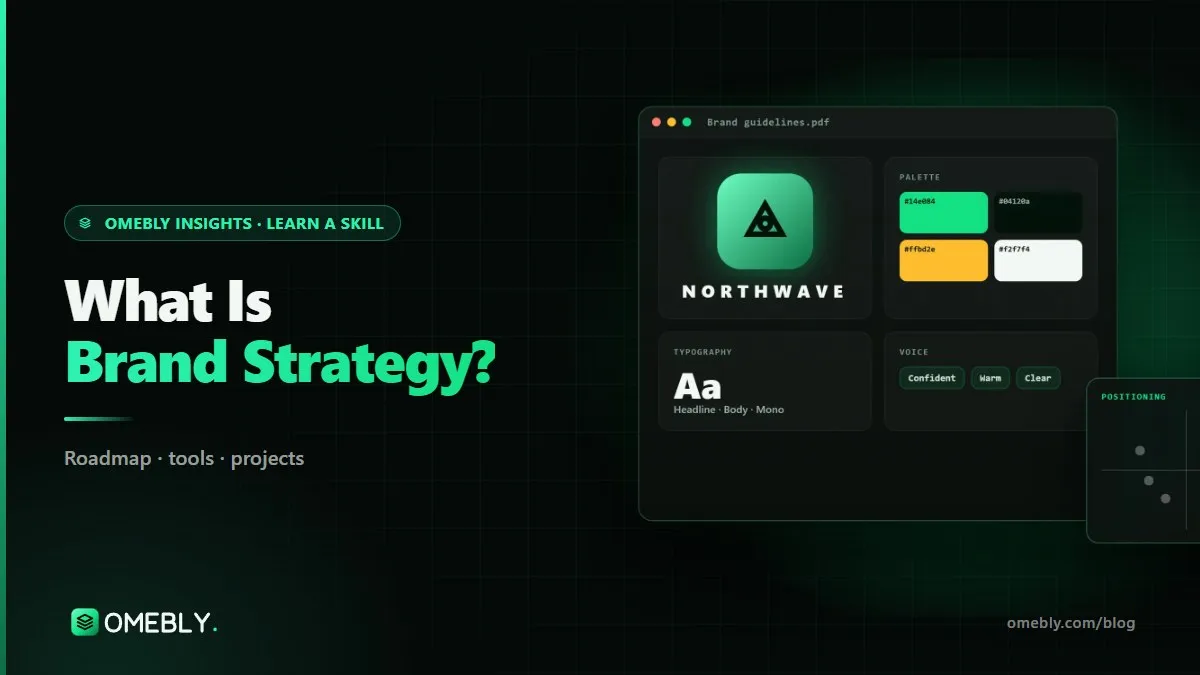
Positioning is the specific place a brand wants to hold in customers’ minds. A simple positioning statement looks like this: “For [audience] who [need], [brand] is the [category] that [key benefit], because [reason to believe].”
Identity direction
Strategy guides identity. That includes naming, a brief for the logo, and a colour and typography system that reflects the brand’s personality. Strategists don’t always design these themselves, but they need to brief and judge them well.
Voice and messaging
How the brand talks: formal or friendly, playful or serious. Messaging includes the tagline, the main value proposition and the key messages for each audience.
Brand guidelines
A brand book records all of this so that designers, marketers, staff and agencies apply the brand consistently.
A worked example: the local café
Imagine a small café near a college. Research shows its regulars are students who stay for hours to study, and their biggest complaints elsewhere are slow Wi-Fi and being rushed out. The positioning might become: “For students who need a calm place to work, this café is the study spot that welcomes you to stay, because it has fast Wi-Fi, plenty of sockets and refills priced for long sessions.”
Every other decision follows from that. The voice is friendly and relaxed. The visual identity uses calm colours and clear signage for sockets and quiet zones. Social posts show people studying, not latte art. The strategy did not need a big budget, only a clear choice about who the café is for.
Brand strategy skills by stage
Stage 1: Foundations and research
- Brand foundations: purpose, mission, vision and values.
- Market and competitor research.
- Audience research and simple personas.
- Writing a positioning statement.
Stage 2: Identity direction
- Naming principles and checking availability.
- Logo direction and creative briefs.
- Colour and typography systems that express the strategy.
- Mood boards in Figma or Miro to align before design starts. The Figma Help Centre is a good place to learn the basics.
Stage 3: Voice, guidelines and launch
- Brand voice and tone rules with do and don’t examples.
- Messaging frameworks and taglines.
- Brand guidelines that people actually read.
- Launch planning: rolling out the brand across website, social and print.
Stage 4: Advanced brand work
- Brand architecture: how a parent brand and sub-brands or products relate.
- Rebranding: when to evolve, when to start fresh and how to manage the change.
- Brand storytelling across channels.
- Brand measurement: awareness, perception and consistency over time.
- Client workshops: running sessions that get founders and teams to agree.
The brand strategy toolkit
- Notion: research notes, strategy documents and brand books.
- Miro: workshops, positioning maps and mood boards.
- Figma: visual direction, mood boards and guideline layouts.
- Illustrator: reviewing and refining logo directions.
- Google Forms: quick surveys for audience research.
- Canva: simple templates that help teams apply the brand.
A month-by-month plan to learn brand strategy
This plan assumes 8–10 hours a week. Choose one real local business, such as a café, salon or shop, and use it throughout.
Month 1: Foundations, research and positioning
Interview three customers of your chosen business and run a short survey. Review five competitors and plot them on a simple positioning map. Write the brand’s purpose, values and a positioning statement.
Month 2: Identity direction
Explore naming options (or evaluate the current name). Write a logo brief and create mood boards for two visual directions. Define a colour palette and type pairing that fit the positioning.
Month 3: Voice, guidelines and launch
Define the brand voice with examples. Write the tagline and key messages. Pull everything into a short brand book and plan how the brand would launch on the website, social media and in the shop.
Months 4–6: Architecture, rebranding and storytelling
Study how larger brands organise sub-brands. Pick a small business with a dated brand and plan a rebrand, explaining what to keep and what to change. Write a brand story and adapt it for three channels.
Months 7–12: Measurement and client work
Learn simple ways to measure brand health, such as surveys and consistency audits. Practise running a workshop with a founder. Complete a full client-style brand project from research to brand book.
Beginner brand strategy projects
- Brand strategy for a local café: research, positioning, voice and visual direction.
- Rebrand of an existing small business: what to keep, what to change and why.
- A personal brand kit: your own positioning, voice and visual identity.
- A brand book for a startup: a complete, usable guidelines document.
How to present brand work
Lead with the problem and the insight from your research, then show how each decision follows from it. Reviewers want to see the reasoning, not only an attractive logo.
Common mistakes beginners make
- Starting with the logo. Design without strategy is guesswork.
- Targeting everyone. A brand for everyone means nothing to anyone.
- Copying competitors. Positioning means finding a different space.
- Skipping research. Assumptions about customers are often wrong.
- Vague values. “Quality” and “innovation” don’t guide decisions.
- Guidelines nobody uses. Keep them short, visual and practical.
- Inconsistency after launch. Strategy only works when it is applied every day.
Brand strategy checklist
- Clear target audience and the problem you solve for them
- A positioning statement with a believable reason to choose you
- Purpose and values that guide real decisions
- Identity direction: name, logo brief, colours and type
- Voice and messaging with examples
- A short, usable brand book and a launch plan
Careers and roles in brand strategy
Brand strategy skills are used by agencies, in-house marketing teams, startups and consultancies. Common roles include:
- Junior brand strategist or strategy assistant: research, competitor reviews and positioning drafts.
- Brand manager: keeping a brand consistent across products and campaigns.
- Brand designer with strategy skills: turning strategy into identity.
- Content or copy strategist: voice, messaging and storytelling.
- Marketing executive with a brand focus.
- Founder or freelance brand consultant: building your own brand or helping small businesses.
Brand strategy pairs naturally with design and marketing. Our guides on learning graphic design online and the digital marketing career path show how these skills connect.
Learn it with Omebly: a live brand strategy course
The Omebly Brand Strategy course follows this path with live, mentor-led classes, recordings for revision and weekly one-on-one reviews. It suits founders building their own brand, designers moving into strategy and marketers who want deeper brand skills. It touches design direction, but the focus is strategy and messaging.
- Core: $699 for 3 months. Brand foundations, market and competitor research and positioning; brand identity with naming, logo direction and colour and typography systems; brand voice and messaging, brand guidelines and launch planning. Includes two capstone projects and an Omebly certificate of completion.
- Professional: $1,199 for 6 months. Adds brand architecture, rebranding and brand storytelling across channels, with four capstone projects, mock interviews and a portfolio review.
- Career: $1,999 for 12 months. Adds brand measurement, client workshops and a full client-style brand project, plus a live client-style project with the Omebly team, unlimited mentor reviews and placement assistance (CV and LinkedIn help, mock interviews, portfolio reviews and referrals where possible).
Tools covered are Figma, Miro, Notion, Illustrator, Google Forms and Canva. Many projects can be built around your own brand. No prior experience is needed, and a free first call checks your level. There is no job promise; your results depend on your effort and the job market.
You can see how brand work is delivered for clients on Omebly’s brand building service.
Book a free call on WhatsApp or through our contact page to get started.
Frequently asked questions
What is the difference between brand strategy and brand identity?
Brand strategy is the thinking: who the brand is for, what it stands for and how it is different. Brand identity is the expression of that strategy: the name, logo, colours, typography and visual style.
Is a brand strategy course a design course?
Not mainly. A good brand strategy course covers design direction, such as logo briefs, colour and type systems, but the focus is research, positioning, messaging and guidelines. Designers, marketers and founders all benefit from it.
Can I use my own business for brand strategy projects?
Yes, and it is a great way to learn. In the Omebly course, many projects can be built around your own brand, so you finish with a strategy you can actually use.
Who should learn brand strategy?
Founders building their own brand, designers who want to move into strategy and marketers who want deeper brand skills. Anyone who makes decisions about how a business presents itself benefits.
Does the Omebly brand strategy course guarantee a job?
No. Omebly offers placement assistance rather than a job guarantee: CV and LinkedIn help, mock interviews, portfolio reviews and referrals where possible. Results depend on your effort and the job market.
How long does it take to learn brand strategy?
The core process, from research and positioning to identity direction, voice and guidelines, can be learned in about three months. Brand architecture, rebranding, storytelling, measurement and client workshops take six to twelve months.

Written by
Nazmul Hussain, Managing Director & Technical Head, Omebly. 10+ years building websites and apps for clients in India, the Gulf, the UK and the US, and mentoring at Omebly Academy. LinkedIn · GitHub
Follow Omebly
New guides, work and launches on every channel.