How to Write a Brand Positioning Statement (With Examples)
A brand positioning statement is a one-paragraph internal promise: who you serve, what you offer and why you're different. Here's a template, examples and how to test yours.
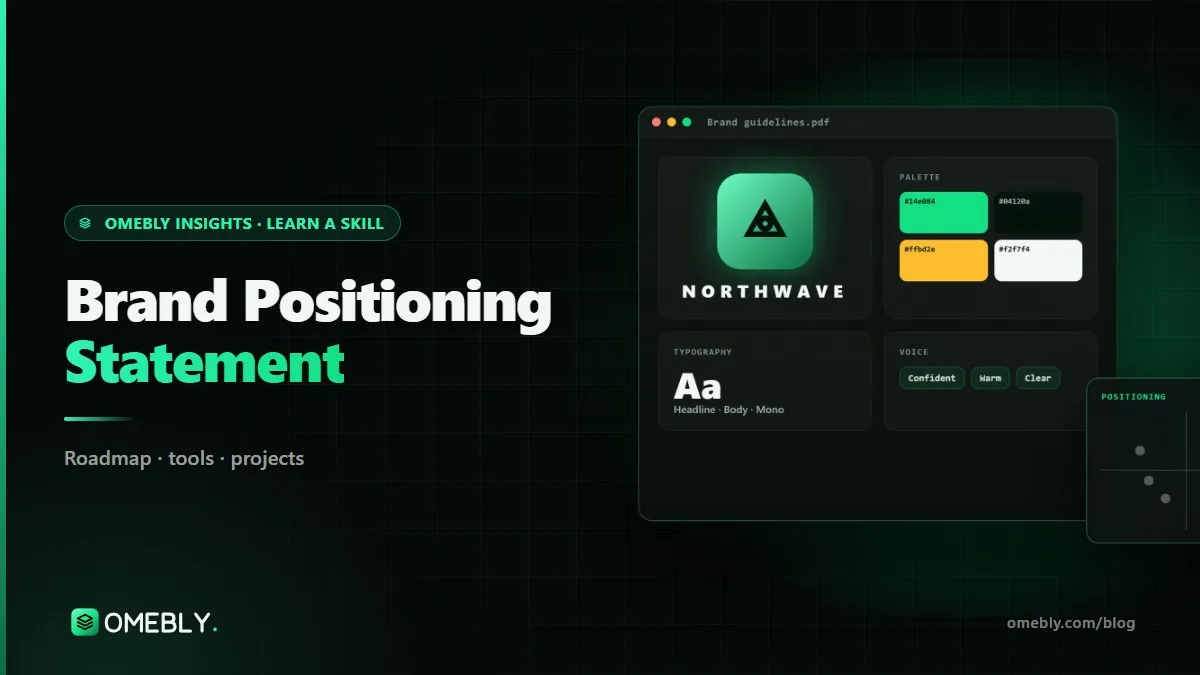
Ask five people in a company what makes their brand different and you’ll often get five answers. A brand positioning statement fixes that. It’s a short, internal paragraph that says who you serve, what you offer and why you, not the alternative. This guide gives you a template, three worked examples and the tests that separate a useful statement from a pretty one. Positioning is also where the Omebly Brand Strategy course starts, in Month 1.
Quick answer: A brand positioning statement is a one to three sentence internal guide that names your target audience, their need, your category, your main benefit and your proof. A simple template is: “For [audience] who [need], [brand] is the [category] that [benefit] because [proof].” Write it from customer and competitor research, then test it for focus, truth and difference.
What a positioning statement is (and isn’t)
A positioning statement is a decision, written down. It tells your team, designers, writers and partners which space your brand wants to own in the customer’s mind.
It is not:
- A tagline. Customers rarely see the positioning statement itself.
- A mission statement. The mission says why you exist; positioning says how you compete.
- A list of features. Features change; positioning should last.
Because it is internal, it can be blunt. “For busy parents who don’t trust street food” is a perfectly good line in a positioning statement, even if you’d never print it on a hoarding.
For how positioning fits with research, identity and voice, read our beginner’s guide to what brand strategy is.
The five parts of a positioning statement
| Part | Question it answers | Weak example | Strong example |
|---|---|---|---|
| Audience | Who exactly is it for? | “Everyone who loves food” | “Working professionals in Salt Lake who eat lunch at their desk” |
| Need | What problem or desire do they have? | “Good food” | “Want a home-style meal they can trust, delivered on time” |
| Category | What do they compare you with? | “Food company” | “Tiffin subscription” |
| Benefit | What’s the main thing they get? | “Quality and taste” | “Fresh, low-oil Bengali meals at their desk by 1 pm” |
| Proof | Why should they believe it? | “We are the best” | “Cooked each morning in a home kitchen, menu shared the night before” |
A simple template
The classic format, popularised by Geoffrey Moore in Crossing the Chasm, still works well:
For [target audience] who [need or problem], [brand] is the [category] that [key benefit]. Unlike [main alternative], we [key difference].
Some teams prefer a version that ends with proof:
For [audience] who [need], [brand] is the [category] that [benefit] because [reason to believe].
Use whichever reads more naturally. What matters is that every blank is specific.
Three brand positioning statement examples
These are imaginary brands, written to show the method. They are not real businesses or Omebly clients.
Example 1: A tiffin service in Kolkata
For office workers in Salt Lake and New Town who want a home-style lunch without the oil and guesswork of takeaway, Maa’s Tiffin is the daily meal subscription that delivers fresh Bengali food to their desk by 1 pm. Unlike delivery apps, every meal is cooked that morning in one home kitchen, and the menu is shared the night before.
Why it works: a precise audience, a real frustration, one clear benefit and proof anyone can check.
Example 2: A B2B software tool
For owners of small clinics who lose bookings to missed calls, ClinicSlot is the online booking tool that fills their diary while they work, because patients book from a live calendar and get automatic reminders.
Why it works: it names the category (online booking tool), so customers know what to compare it with, and the benefit is an outcome, not a feature list.
Example 3: A freelance designer
For new D2C skincare brands in India that need to look established from day one, Riya Studio is the packaging and identity designer who delivers a launch-ready brand in four weeks. Unlike general agencies, Riya works only with skincare, so every project starts with category research she has already done.
Why it works: narrowing to one industry is a strength, not a limit. It makes the proof believable.
How to write yours, step by step
Step 1: Talk to customers
Interview five to ten real or ideal customers. Ask what they used before, what annoyed them, and the words they use to describe the problem. A short Google Form helps you reach more people, but conversations give the best language.
Step 2: Map your competitors
List the alternatives customers actually consider, including “do nothing” or “do it myself”. Note what each one claims. A simple 2×2 map, such as price against convenience, often reveals an empty space.
Step 3: Choose one audience
Pick the group you can serve best, not the biggest one. You can widen later; a vague audience produces a vague brand.
Step 4: Pick one benefit you can own
Look for the overlap between what customers care about, what you’re genuinely good at and what competitors don’t claim. That overlap is your position.
Step 5: Find your proof
Proof can be a process, an ingredient, a specialism, a promise you can actually keep or a founder’s expertise. “Best quality” isn’t proof; “cooked the same morning” is.
Step 6: Draft, then cut
Write three versions, read them aloud, and remove every word that could apply to any brand. Keep it to one paragraph.
Five tests for a strong positioning statement
- The swap test. Replace your brand name with a competitor’s. If the statement still works, it isn’t distinctive.
- The truth test. Can you deliver this every day, not just on a good day?
- The customer test. Would your best customer nod and say “yes, that’s why I chose you”?
- The decision test. Does it help you say no to some work, products or channels?
- The design test. Could a designer use it to choose colours, typography and imagery? If it gives them nothing, it’s too abstract.
Common mistakes
- Targeting everyone. “For all ages and budgets” positions you nowhere.
- Using empty adjectives. “Innovative”, “premium” and “customer-first” say nothing on their own.
- Copying the market leader. Positioning is about difference, not imitation.
- Writing it alone. Involve sales, support and the founder; they hear customers every day.
- Leaving it in a drawer. Share it with everyone who writes, designs or sells for the brand.
Putting the statement to work
A positioning statement earns its keep when it shapes everything else. Use it to brief your visual identity, write your homepage headline, choose ad messages and decide which products to launch. Some teams build a one-page brand board in Figma with the statement at the top and the colours, fonts and tone beneath it, so nobody has to guess.
Positioning checklist
- Five to ten customer conversations done
- Main alternatives listed and mapped
- One specific audience chosen
- One benefit you can own
- Proof that is true and checkable
- Passed the swap, truth and decision tests
- Shared with the whole team
How Omebly can help
The Omebly Brand Strategy course is live and mentor-led, with recordings and weekly one-on-one reviews. Core ($699, 3 months) covers brand foundations, market and competitor research and positioning, then identity (naming, logo direction, colour and typography systems), voice, messaging, guidelines and launch planning. Professional ($1,199, 6 months) adds brand architecture, rebranding and storytelling across channels, with mock interviews and a portfolio review. Career ($1,999, 12 months) adds brand measurement, client workshops, a live client-style project and placement assistance. Tools include Figma, Miro, Notion, Illustrator, Google Forms and Canva, and you get an Omebly certificate of completion. There is no job promise.
If you’d rather have a team build your brand, Omebly’s brand building service does it for businesses. Ask us anything on WhatsApp or through the contact page.
Fill in the five blanks for your own brand today, then run the swap test on it.
Frequently asked questions
What is a brand positioning statement?
It's a short internal statement that says who your brand serves, what need it meets, what category it competes in, its main benefit and why people should believe it. It guides decisions on messaging, design and product.
Is a positioning statement the same as a tagline?
No. A positioning statement is internal and usually one to three sentences long. A tagline is a short public line inspired by the positioning, written for customers.
What's the difference between positioning and a value proposition?
Positioning describes where your brand sits in the customer's mind compared with alternatives. A value proposition describes the specific value a customer gets from a product or offer. A brand often has one positioning and several value propositions.
How often should a positioning statement change?
Not often. Review it once a year or when something big changes, such as a new audience, a new competitor or a new product line. Changing it every quarter confuses your team and your customers.
Can a small business or freelancer use a positioning statement?
Yes, and it often helps them most. A clear statement makes it easier to write your website, choose which clients to pursue and say no to work that doesn't fit.
Does the Omebly brand strategy course cover positioning?
Yes. Month 1 of the Core track covers brand foundations, market and competitor research, and positioning. Placement assistance is included in the Career track; there is no job guarantee.

Written by
Nazmul Hussain, Managing Director & Technical Head, Omebly. 10+ years building websites and apps for clients in India, the Gulf, the UK and the US, and mentoring at Omebly Academy. LinkedIn · GitHub
Follow Omebly
New guides, work and launches on every channel.