How to Position Your Brand Where Competitors Aren't Already Standing
Most brands sound alike because they copy the category. Here's a practical method to map competitors, spot the gaps customers care about and choose a position you can actually own.
Walk through any category, whether it’s dental clinics, accounting firms, interior designers or SaaS tools, and you’ll notice the same promises again and again: quality, trust, innovation, customer-first. When everyone says the same thing, buyers fall back on the only difference left, which is price. Learning how to position your brand is really learning how to find a place in the buyer’s mind that your competitors haven’t already claimed, and that you can genuinely deliver.
This guide walks through the method we use in brand strategy and positioning projects, written so a business owner can run a first version with their own team.
Quick answer: To position your brand, list the five to eight alternatives your customers actually compare you with, map them on the two or three factors buyers care about most, and look for open space that matches a real customer need. Then choose the position you can prove today, narrow your audience if needed, and test it against customer language before you design anything.
Why most brands end up in the same spot
Positioning fails for predictable reasons:
- Copying the category leader. New businesses study the biggest competitor and borrow its look and language. The result looks professional but forgettable.
- Describing features, not choices. “We offer web design, SEO and hosting” lists services. It doesn’t say why someone should choose you over the next agency with the same list.
- Trying to appeal to everyone. A brand that serves “all businesses” has no natural home in anyone’s mind.
- Using internal language. Teams describe themselves in terms customers never use, so even a good idea doesn’t land.
The fix is not a cleverer tagline. It is a deliberate choice, made with evidence, about where you stand.
Step 1: Define the real alternatives
Your competitors are not only the businesses that look like you. They are whatever your customer would do instead. For a bakery taking custom cake orders, that might be another bakery, a supermarket cake, a home baker on Instagram, or simply skipping the cake.
Ask your sales or customer service team two questions:
- Who did the customer mention comparing us with?
- When we lost a deal, what did they choose instead?
Write down five to eight names or options. Include at least one “do nothing” or “do it ourselves” alternative, because that is often the real competitor.
Step 2: Find out what buyers actually weigh up
A positioning map is only useful if its axes matter to customers. Founders often pick axes that matter to them, such as technology or years of experience, while customers care about speed, reliability or how easy you are to deal with.
Where to find the factors
- Reviews. Read the three-star and four-star reviews of your competitors and yourself. They explain what people wanted and didn’t quite get.
- Enquiry messages. The first question someone asks on WhatsApp or email tells you what they care about most.
- Lost-deal notes. Price is often the stated reason, but look for the reason behind it.
- Search behaviour. Tools such as Google Trends show how interest in different phrases compares over time, which hints at how people describe the need.
Collect the actual words people use. You’ll need them later for messaging.
Step 3: Map competitors on a positioning grid
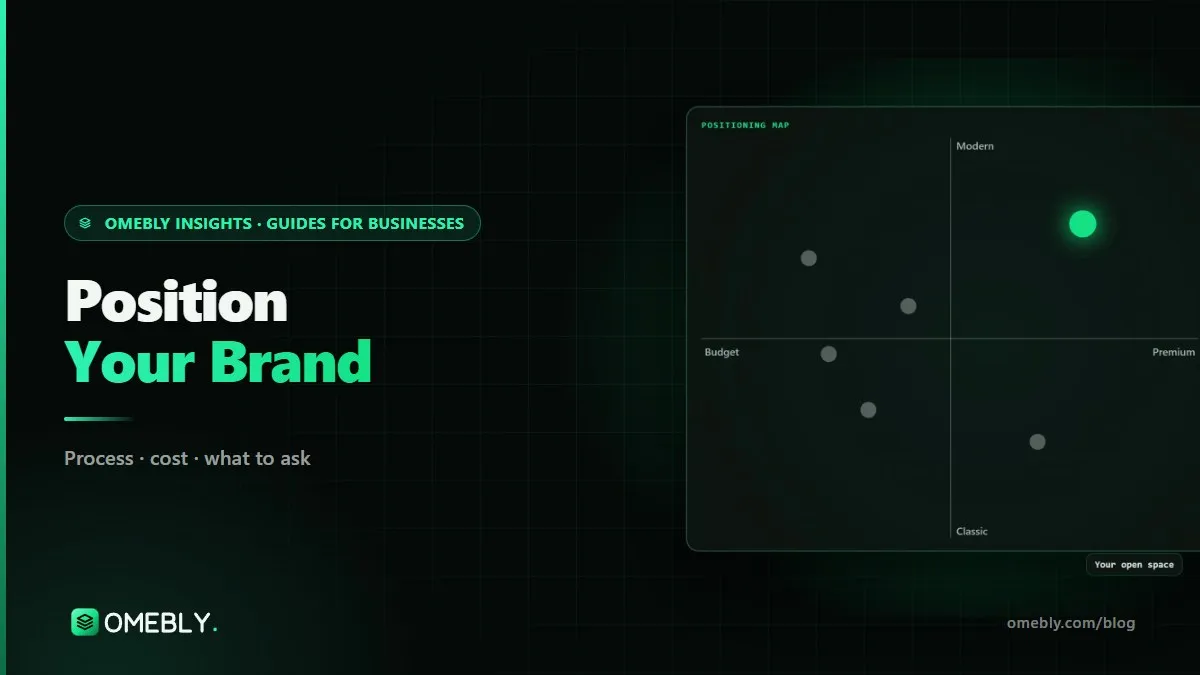
Pick the two factors that come up most often and draw a simple grid. Place each alternative on it based on evidence: their website promises, pricing, reviews and ads, not your opinion of them.
| Factor pair | Example category | What the map often shows |
|---|---|---|
| Price level vs speed | Printing, repairs, design studios | Cheap-and-slow and premium-and-slow are crowded; fast is open |
| Specialist vs generalist | Accounting, legal, agencies | Most firms claim to do everything |
| Self-service vs done-for-you | Software, fitness, education | Few offer a guided middle option |
| Formal vs friendly | Clinics, finance, B2B services | Almost everyone sounds formal |
| Local vs international | Services sold across India, UAE and UK | Few combine local presence with cross-border delivery |
Draw two or three versions with different factor pairs. The useful map is the one where competitors cluster and leave a clear space.
Look at tone and visuals too
Positioning is not only what you promise but how you look and sound. Screenshot competitors’ homepages and social profiles and lay them side by side. If every brand uses navy blue, stock photos of handshakes and the word “solutions”, that is a gap as well, and it becomes useful later when you brief a designer.
Step 4: Test each gap against three questions
Empty space on a map is not automatically a good position. Some spaces are empty because nobody wants to be there. Before you claim one, ask:
- Do customers want it? Is there evidence in reviews, enquiries or interviews that buyers value this?
- Can we deliver it today? If you promise fast turnaround, your operations must already be fast, or you need a plan to make them fast before you say so.
- Is it hard to copy? A position based on a specific process, specialism or audience lasts longer than one based on a discount.
If a gap passes all three, it’s a candidate. If none pass, narrow the audience and map again. “Accounting for everyone” may be crowded, while “accounting for Indian founders setting up in the UAE” may be wide open.
Step 5: Choose, and decide what you’ll leave out
This is the hard part. A position means saying no: to some customers, to some services you could lead with, and to some ways of talking about the business. Write down:
- Who we are for, in one specific sentence.
- Who we are not for, which helps the team turn away poor-fit work.
- The one thing we want to be known for.
- The proof: process details, guarantees you can genuinely offer, specialisms, or how you work, that make the claim believable.
Keep this as a short internal document. It is the reference every design, copy and sales decision is checked against.
Step 6: Test the position before you design
Before spending on a new logo or website, put the position in front of real people:
- Read a one-line version to three or four existing customers and ask if it sounds like you.
- Rewrite your homepage headline using the new position and compare enquiries over a few weeks.
- Ask your sales team to use the new explanation on calls and report which questions come back.
If people respond with “yes, that’s exactly why we chose you”, you’ve found it. If they look puzzled, the wording or the position needs work. Once it’s settled, the position feeds directly into your tone of voice and messaging, and then into the visual identity.
Common positioning mistakes to avoid
- Choosing a gap you can’t fill. Promising something your business can’t deliver damages trust faster than having no position at all.
- Positioning on a feature competitors can copy next month. A new tool or a discount is not a position.
- Ignoring the “do nothing” option. Many sales are lost to inaction, not to rivals.
- Changing position every quarter. Recognition builds through repetition. Review once a year or when the business changes significantly.
- Letting one opinion decide. A workshop with evidence in the room avoids the loudest voice winning.
- Jumping straight to design. A designer can only make you look different once you’ve decided what makes you different. Our brand identity guide explains how strategy feeds the logo, colours and voice.
How to position your brand: a checklist
- Five to eight real alternatives listed, including “do nothing”
- Customer words collected from reviews, enquiries and lost deals
- Two or three positioning maps drawn on factors buyers care about
- Competitor visuals and tone compared side by side
- Each gap tested: wanted, deliverable, hard to copy
- Target audience written in one specific sentence
- “Not for” list agreed
- Proof points listed for the main claim
- Position tested with customers and the sales team
- Short internal positioning document shared with the team
How Omebly can help
If you’d rather not run this alone, Omebly’s brand positioning service covers the competitor landscape matrix, customer interviews or a survey, a strategy workshop with your team, and a written value proposition and positioning statement. It’s the first stage of our wider brand building work, and the hand-over turns the strategy into a clear brief for whoever designs next. Projects are led by our founder, Nazmul Hussain, with a fixed written quote after a free consultation and milestone payments after each stage.
We work with businesses in Kolkata, Downtown Dubai and further afield, on calls in your time zone. Tell us about your market on the contact page or on WhatsApp at +91 70444 33991.
Draw your first positioning map this week; the gap is often more obvious on paper than in your head.
Frequently asked questions
How many competitors should I look at when positioning my brand?
Usually five to eight. Include the two or three names customers mention most, one or two newer entrants and at least one alternative that isn't a direct competitor, such as doing the job in-house. More than ten makes the map hard to read without adding much.
What if every position in my market is already taken?
It rarely is once you look at combinations. A gap is often a pairing nobody owns, such as premium quality with fast turnaround, or a specialist focus on one customer type. Narrowing the audience is the most common way to find open space.
Can I position my brand on price?
You can, but it is the easiest position to lose, because a competitor only has to cut their price. If low price is genuinely central to your model, pair it with something harder to copy, such as a simpler process or a specific audience.
How long does a positioning take to show results?
There is no fixed timeline. The first visible change is usually internal: clearer sales conversations and quicker design and copy decisions. Customer perception changes more slowly and depends on how consistently the position is used across your website, ads and service.
Should a positioning change for different countries?
The core idea usually holds, but the competitors and cues differ. A brand selling in Kolkata and Dubai may face different rivals, so it is worth mapping each market separately and adjusting the emphasis rather than the whole position.
Is positioning only for new businesses?
No. Established businesses often need it more, especially when growth has added services or markets and the brand no longer says one clear thing. Revisiting positioning is also a sensible first step before any rebrand.

Written by
Nazmul Hussain, Managing Director & Technical Head, Omebly. 10+ years building websites and apps for clients in India, the Gulf, the UK and the US, and mentoring at Omebly Academy. LinkedIn · GitHub
Follow Omebly
New guides, work and launches on every channel.