How to Define Your Brand's Tone of Voice, With Examples
The same message can sound warm, expert or playful. Here are tone of voice examples for real business moments, and a simple method to define a voice your whole team can write in.
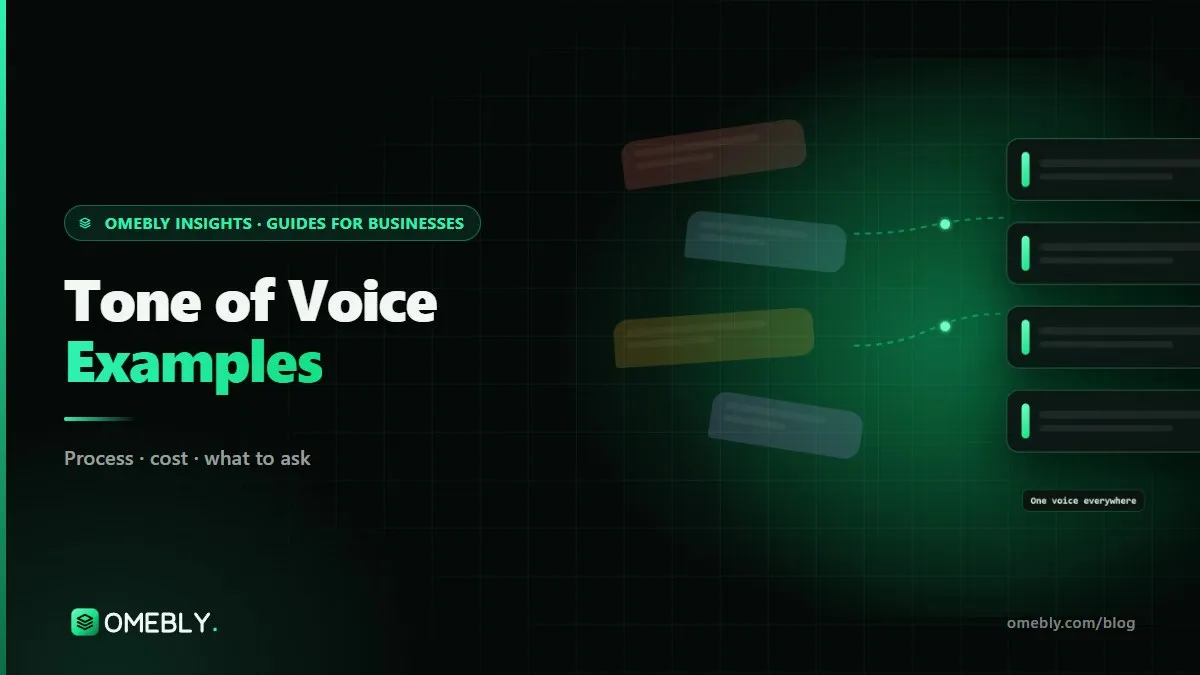
Two businesses can sell the same thing at the same price and still feel completely different, because of how they talk. One sounds like a careful professional, the other like a helpful friend. That difference is tone of voice. The fastest way to understand it is through tone of voice examples: the same message written several ways, so you can hear which one sounds like your business.
This guide gives examples for real business moments, then a step-by-step way to define your own voice. It follows the approach we use in our brand messaging services.
Quick answer: Your brand voice is your consistent personality in words; your tone is how that voice adjusts to the situation. To define it, audit how you currently write, choose three or four voice principles with “this, not that” examples, place yourself on a few tone scales such as formal to casual, and show how tone flexes by channel. Then rewrite real copy in the new voice so everyone can hear it.
Voice versus tone in one minute
Think of a good doctor. Their voice, calm, clear and knowledgeable, stays the same with every patient. Their tone changes: lighter with a child, slower with a worried relative, more technical with a colleague.
Brands work the same way. Mailchimp’s voice and tone guide describes it well: the voice stays consistent while the tone adapts to the reader and the moment. Your website, ads, invoices and support replies should all sound like one company, but not identical in every situation.
Tone of voice examples: one message, three voices
Here’s the same message written for three imaginary businesses with different personalities. None of these are real clients.
A delivery update
- Formal and precise (a logistics firm): “Your consignment has been dispatched and is scheduled for delivery on Thursday, 22 October.”
- Warm and reassuring (a home bakery): “Good news! Your cake is on its way and should reach you on Thursday. We’ve packed it carefully.”
- Playful and bold (a snack brand): “It’s happening. Your snacks have left the building and land on Thursday. Hide them well.”
A homepage headline
- Expert: “Accounting and tax advice for growing businesses in India and the UAE.”
- Friendly: “Your books, sorted. Tax and accounts help for busy founders.”
- Bold: “Stop dreading tax season.”
A delay or apology
- Formal: “We regret to inform you that your order has been delayed. We apologise for any inconvenience.”
- Warm and direct: “Sorry, your order is running two days late because our supplier missed a delivery. It will now arrive on Saturday, and we’ll message you when it’s out.”
The second apology is better for most brands, whatever their voice: it says sorry plainly, explains why, and gives a new date. Tone flexes, but clarity is always in fashion.
A WhatsApp reply to a price enquiry
- Off-voice (vague): “Dear sir, kindly share your requirement for best price.”
- On-voice (clear and friendly): “Hi Priya, thanks for getting in touch. Could you tell us roughly how many pages you need and when you’d like to launch? We’ll send a written quote within a day or two.”
An out-of-stock message
- Formal: “This item is currently unavailable. Please check again later.”
- Warm and helpful: “This one has sold out for now. We expect more next week; leave your number and we’ll message you when it’s back.”
- Playful: “Gone! Everyone wanted one. Leave your number and we’ll tell you the moment it’s back.”
A sales follow-up email
- Expert: “Following our call on Tuesday, I’ve attached a proposal covering scope, timeline and milestones. I’d be glad to walk your team through it.”
- Friendly and direct: “Great speaking on Tuesday. Your proposal is attached: what’s included, when, and what it costs. Shall we go through it together on a short call?”
Notice that every version is clear about the next step. Personality changes the colour of the words, not the information. When you compare examples like these with your team, ask which one your best salesperson or customer service lead would naturally say. That is usually the closest starting point for your voice.
How to define your brand’s tone of voice
Step 1: Start from your positioning
Your voice should express who you are for and why you’re different. A brand positioned on speed should sound brisk; one positioned on care should sound patient. If your positioning isn’t clear yet, start with our guide on how to position your brand.
Step 2: Audit how you sound today
Collect ten pieces of real writing: homepage, about page, a proposal, a few social posts, an invoice email, a support reply and a WhatsApp message. Read them aloud in one sitting. Note:
- Which ones sound most like you at your best.
- Where the voice changes completely between writers.
- Words customers use in reviews and enquiries that you never use yourself.
Step 3: Write three or four voice principles
Each principle needs a name, a sentence explaining it and a “this, not that” pair. For example:
| Principle | What it means | This | Not that |
|---|---|---|---|
| Clear, not clever | Plain words first; wordplay only if it helps | “We reply within a day.” | “Lightning-fast synergy.” |
| Confident, not boastful | State what we do and show proof | “Every project has a fixed written quote.” | “We’re the best in the business!” |
| Warm, not over-familiar | Friendly and polite, never pushy | “Happy to help. What do you need?” | “Hey buddy!! What’s up?” |
| Specific, not generic | Details over adjectives | “Three logo directions, shown on real signs.” | “Amazing, world-class designs.” |
Step 4: Place yourself on tone scales
Choose three or four pairs and mark where your brand sits by default:
- Formal ◀──▶ Casual
- Serious ◀──▶ Playful
- Expert ◀──▶ Plain-spoken
- Reserved ◀──▶ Enthusiastic
A default position stops the voice swinging with whoever is writing.
Step 5: Show how tone flexes by channel
| Channel | Tone shift from your default | Example note |
|---|---|---|
| Website | Default | Clear headlines, short paragraphs |
| Slightly more expert | Share process and lessons | |
| Slightly more relaxed | Shorter lines, more personality | |
| Support and complaints | Calmer and more direct | No jokes; apologise, explain, give next step |
| Invoices and contracts | More formal | Precise and complete |
Step 6: Write a word list and before-and-after rewrites
List words you use (and why) and words you avoid, such as “solutions”, “leverage” or “kindly revert”. Then rewrite three real pieces of copy, such as your homepage hero, an about paragraph and a support reply. Rewrites make the voice concrete in a way principles alone can’t.
Mistakes to avoid
- Choosing adjectives every brand claims. “Professional, friendly, innovative” doesn’t guide anyone.
- No examples. Principles without “this, not that” pairs are open to interpretation.
- Forcing humour everywhere. Jokes in a complaint reply damage trust.
- Copying a famous brand’s voice. It rarely fits your audience or your positioning.
- Writing the guide and never sharing it. A short walkthrough with everyone who writes is essential.
- Ignoring customer language. Your voice should use the words customers use to describe their problem.
Tone of voice checklist
- Positioning agreed before defining the voice
- Ten real pieces of writing audited
- Customer words collected from reviews and enquiries
- Three or four voice principles with “this, not that” examples
- Default position on three or four tone scales
- Channel-by-channel tone notes
- Words to use and avoid
- Three before-and-after rewrites of real copy
- Guide shared with everyone who writes, including agencies
How Omebly can help
Omebly’s tone of voice and messaging service starts with a language audit and a workshop, then delivers a messaging framework, voice principles, a tone spectrum, elevator pitches, tagline options and a copywriting guidebook with before-and-after rewrites of your own copy. The voice section can sit inside your visual brand guidelines as one brand book. It’s part of our wider brand building service, led by our founder, Nazmul Hussain, with a fixed written quote after a free consultation.
Send us a few pieces of your current copy through the contact page or on WhatsApp at +91 70444 33991, and we’ll talk through how your brand should sound.
Rewrite one customer message in your chosen voice today; you’ll learn more from that than from any adjective list.
Frequently asked questions
How many tone of voice principles should a brand have?
Three or four. Fewer than three rarely describes a personality fully, and more than four becomes hard to remember while writing. Each principle should come with a short explanation and a 'this, not that' example.
Can a small business have a tone of voice without a style guide?
Yes. A single page with your principles, a few example sentences and a list of words to use and avoid is enough to start. The important part is that everyone who writes for the business has seen it.
Should our tone of voice be the same as the founder's personal style?
It can draw on it, especially in a small business where the founder is the face of the brand. But write it down as the brand's voice, so that staff, agencies and future hires can use it without imitating one person.
How do we write in our brand voice in Hindi, Bengali or Arabic?
Share the principles and examples with a native-speaking writer and ask them to adapt rather than translate. Formality, humour and politeness work differently across languages, so the personality should carry over even when the exact words don't.
Is it worth testing tone of voice with customers?
It can help. Show two versions of the same message, such as a homepage headline or a reminder message, to a few customers and ask which sounds more like a business they'd trust. Their reactions are often clearer than internal debate.
What is the quickest way to spot copy that is off-voice?
Read it aloud. If it sounds like a different company, or like something your staff would never say to a customer in person, it is off-voice. A short checklist of your principles helps writers check each piece before publishing.

Written by
Nazmul Hussain, Managing Director & Technical Head, Omebly. 10+ years building websites and apps for clients in India, the Gulf, the UK and the US, and mentoring at Omebly Academy. LinkedIn · GitHub
Follow Omebly
New guides, work and launches on every channel.