Shopify vs WooCommerce vs Custom Store: What Suits Indian Sellers?
Shopify, WooCommerce or a custom build? A practical comparison for Indian sellers on cost, payments, GST, COD, shipping and how much control you really need.
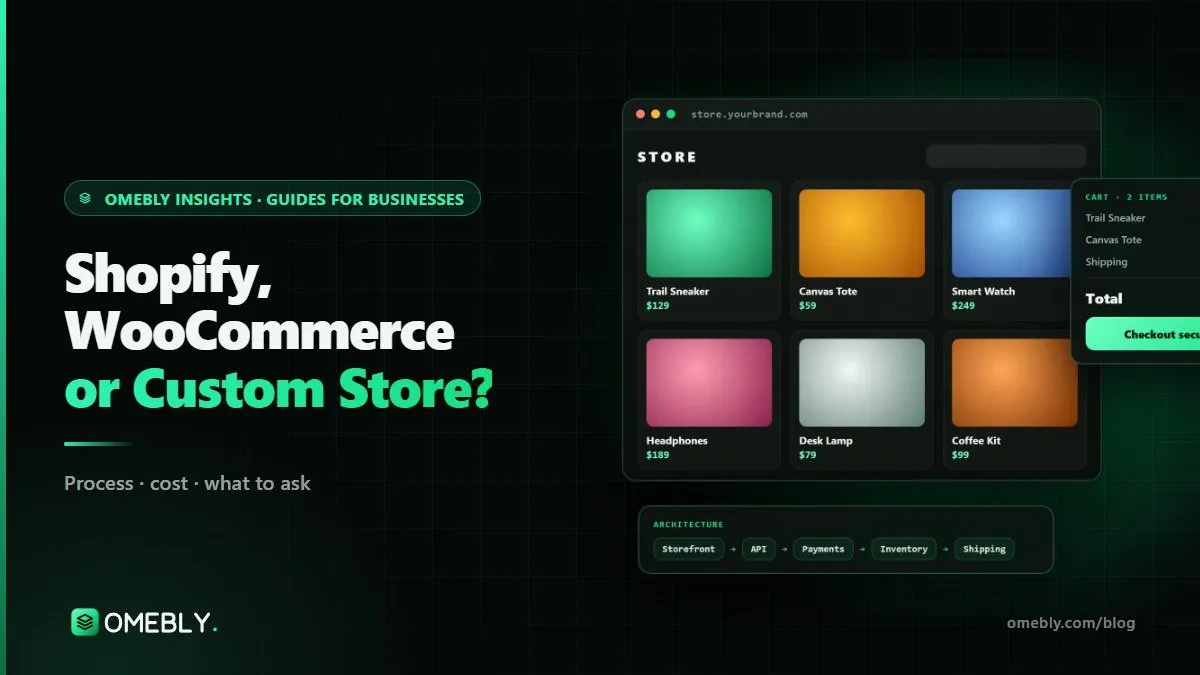
Every Indian seller who outgrows Instagram DMs or a marketplace listing hits the same question: Shopify, WooCommerce or a custom-built store? The right answer depends less on which platform is “best” and more on your catalogue, payments, delivery model and how much control you need. This guide compares Shopify vs WooCommerce in India, side by side with a custom store, on the things Indian sellers actually deal with: UPI, COD, GST invoices, couriers and costs.
We build stores on all three through our e-commerce website service, so this is the same honest comparison we give in a first call.
Quick answer: Choose Shopify if you want to launch fast with little technical upkeep and can accept monthly fees plus a third-party transaction fee. Choose WooCommerce if you already use WordPress, want lower platform fees and more control, and have someone to maintain it. Choose a custom store only when your business logic, such as B2B pricing, multi-seller marketplaces or ERP integration, doesn’t fit a platform.
The three options in one paragraph each
Shopify is a hosted platform. You pay a monthly plan, Shopify runs the servers, security and checkout, and you extend the store with themes and apps. Plans are billed in INR in India.
WooCommerce is a free plugin that turns a WordPress site into a store. You choose and pay for hosting, and you (or your developer) look after updates, security and backups. You can change almost anything.
A custom store is built for your business, often with a modern framework on the front end and your own back end or a headless commerce engine. You own every line of code, and you pay for that flexibility in build time.
Shopify vs WooCommerce India: side by side
| Shopify | WooCommerce | Custom store | |
|---|---|---|---|
| Time to launch | Fastest | Moderate | Longest |
| Hosting | Included | You arrange it | You arrange it |
| Monthly platform fee | Yes, by plan | No (hosting instead) | No (hosting instead) |
| Extra transaction fee with Indian gateways | Yes, by plan | No | No |
| Technical upkeep | Low | Medium to high | Depends on build and support |
| Design freedom | High within themes | Very high | Total |
| Complex B2B or marketplace logic | Limited, via apps | Possible, via plugins | Built exactly as needed |
| Best for | New and growing D2C brands | WordPress users, content-heavy brands | Unusual models, scale, deep integrations |
Payments: UPI, cards, wallets and COD
Indian shoppers expect UPI, cards, net banking, wallets and often cash on delivery.
Shopify
Shopify Payments isn’t offered in India, so Indian stores connect a third-party gateway such as Razorpay, PayU or Cashfree. On top of the gateway’s own fee, Shopify charges a third-party transaction fee that depends on your plan. Razorpay’s Shopify pricing explainer breaks this down; check Shopify’s current pricing before you decide, because a small percentage adds up quickly at volume.
WooCommerce
Major Indian gateways offer official WooCommerce plugins. There is no platform fee on each order; you pay only the gateway’s charges. The trade-off is that you are responsible for keeping those plugins updated and tested.
Custom
Your developer integrates the gateway’s API directly. It takes more work upfront but gives full control over the checkout flow, such as part-payment, B2B credit terms or custom COD rules.
Cash on delivery
All three support COD. What matters more is control: limits by order value, extra fees, PIN-code rules and OTP or WhatsApp confirmation to cut fake orders. Shopify and WooCommerce handle much of this through apps and plugins; a custom store builds it in.
GST, invoices and compliance
Indian sellers need GST-compliant invoices with GSTIN, HSN codes and the right tax split (CGST and SGST, or IGST for interstate orders).
- Shopify: tax settings plus an invoicing app for GST-format invoices.
- WooCommerce: tax tables plus a GST invoice plugin.
- Custom: built to your accountant’s exact format, and can sync with Tally or an ERP.
Whatever you pick, show your return, refund and grievance details clearly. India’s Consumer Protection (E-Commerce) Rules, 2020 expect sellers to display them.
Shipping and couriers
Most Indian stores use a shipping aggregator to book couriers, print labels and check PIN-code serviceability. Popular aggregators offer both Shopify apps and WooCommerce plugins, so neither platform has a real advantage here. A custom store connects to the aggregator’s API, which also lets you show accurate delivery dates on product pages.
The real cost of each option
Think in total cost over two to three years, not launch cost.
Shopify costs
- Monthly plan (in INR)
- Theme (free or a one-off paid theme)
- Paid apps, often monthly
- Third-party transaction fee per order, plus gateway fees
- Developer time for setup, customisation and design
WooCommerce costs
- Hosting that can handle traffic peaks (cheap shared hosting struggles during sales)
- Domain, SSL, theme and paid extensions
- Security, backups and updates, usually through a maintenance plan
- Gateway fees
Custom store costs
- A larger one-time build
- Hosting and monitoring
- Ongoing development for new features
Our WordPress vs custom website guide goes deeper into the maintenance side of plugin-based sites versus custom code.
Which one should you choose?
Choose Shopify if…
- You are launching your first D2C brand and want to sell within weeks.
- You don’t have a developer on call and don’t want to manage hosting.
- Your catalogue and checkout are fairly standard.
- You are happy to trade some fees for convenience.
Choose WooCommerce if…
- Your business already runs on WordPress, or content and blogging matter as much as products.
- You want lower ongoing platform fees and full ownership of your data.
- You have a developer or agency for updates and security.
- You need flexibility in product types, pricing rules or checkout fields.
Choose a custom store if…
- You sell to businesses with customer-specific price lists, credit terms or bulk ordering.
- You run a multi-vendor marketplace or a subscription model that platforms handle awkwardly.
- Your store must sync tightly with an ERP, warehouse or POS system.
- You have outgrown a platform’s speed or limits and have the budget to build properly.
For most new Indian sellers, the honest answer is Shopify or WooCommerce first, and custom later when the business has proven its model.
Mistakes Indian sellers make when choosing
- Choosing on launch cost alone. The cheapest store to build can be the most expensive to run.
- Installing too many apps or plugins. Each one slows the store and adds risk; remove what you don’t use.
- Cheap hosting for WooCommerce. It usually fails on the first big sale day.
- Ignoring mobile. Most Indian shoppers buy on mid-range Android phones. Test there.
- Not owning your accounts. Domain, platform, gateway and courier accounts should be in your name.
- Migrating right before a festive sale. Plan moves for quieter months.
A quick decision checklist
- I know my catalogue size and product types
- I know which payment methods and COD rules I need
- I have compared total cost over two to three years
- I know who will maintain the store after launch
- I have listed integrations (couriers, ERP, Tally, WhatsApp)
- Domain and all key accounts will be in my name
- I have a launch date that avoids peak season
How Omebly can help
Omebly builds online stores on Shopify, WooCommerce and custom stacks for sellers in India, the UAE and beyond. Our e-commerce website service covers the product catalogue, filters and cart, payment gateways such as Razorpay, Stripe and PayPal, shipping and tax rules, order and stock management, abandoned cart emails, analytics and team training. We can also migrate an existing store, including products, customers and order history where the platform allows.
Stores start from $4,000, with a fixed written quote after a free consultation, and you own the code and designs when paid in full. For stores we build, our support policy covers free fixes for bugs in our own work. If you are still deciding whether you need a custom site at all, start with our custom website development guide.
Not sure which platform fits your products? Contact us or message us on WhatsApp for a straight answer.
Frequently asked questions
Is Shopify or WooCommerce better for India?
Shopify suits sellers who want a store running quickly with little technical upkeep. WooCommerce suits sellers who already use WordPress or need more control and lower monthly platform fees. Both work well with Indian payment gateways, UPI, COD and courier apps.
Is Shopify Payments available in India?
No. Indian Shopify stores use a third-party gateway such as Razorpay, PayU or Cashfree. Shopify then charges a third-party transaction fee on top of the gateway fee, which depends on your plan, so check Shopify's current pricing page.
Is WooCommerce free?
The plugin is free, but the store is not. You pay for hosting, a domain, a theme, some paid extensions, security, backups and a developer's time for updates. Over a year, a well-run WooCommerce store has real costs.
When does a custom ecommerce website make sense in India?
When your business logic doesn't fit a platform: B2B price lists, complex product configurators, marketplaces with many sellers, deep ERP integration or very high traffic. For most new D2C brands, Shopify or WooCommerce is the sensible start.
Can I move from Shopify to WooCommerce or a custom store later?
Yes. Products, customers and often order history can be migrated, and URLs can be redirected to protect SEO. Plan migrations for a quiet season, not just before Diwali or a big sale.
How much does an ecommerce website cost with Omebly?
Omebly's e-commerce stores start from $4,000 (USD), on Shopify, WooCommerce or a custom stack, with a fixed written quote after a free consultation.

Written by
Nazmul Hussain, Managing Director & Technical Head, Omebly. 10+ years building websites and apps for clients in India, the Gulf, the UK and the US, and mentoring at Omebly Academy. LinkedIn · GitHub
Follow Omebly
New guides, work and launches on every channel.